How a walkie-talkie works: one radio that sends and listens
A walkie-talkie holds two radios in one case. The transmitter sends your voice, and the receiver plays the voices of others. Kenwood's manual calls the whole set a transceiver.1
The push-to-talk button, or PTT, switches between the two. Hold it and the radio sends. Let go and it listens again.21
So only one person on a channel talks at a time. Radio people call this half-duplex: you talk or you listen, never both at once. A phone call lets both sides speak together; a walkie-talkie makes you take turns.
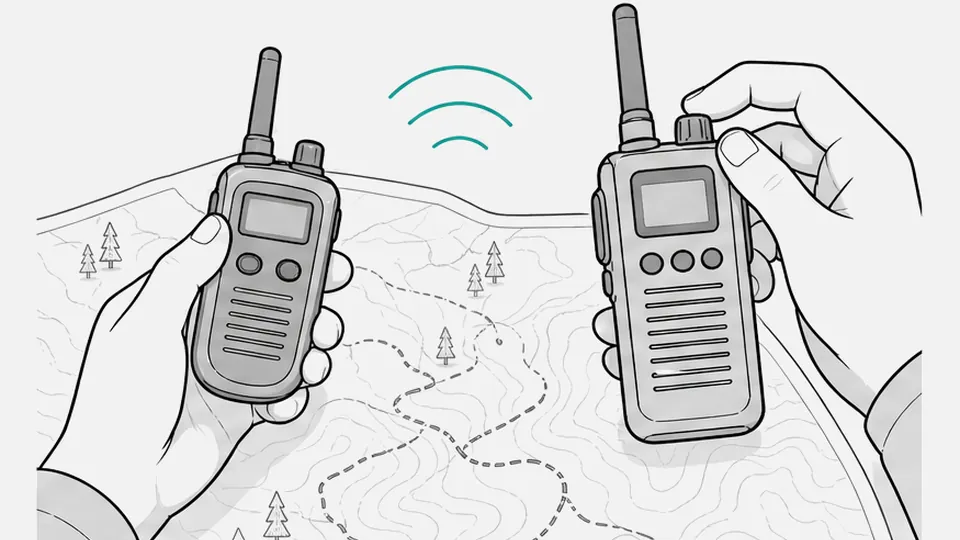
The signal goes straight from one radio to the other. There is no phone network, no SIM card and no call charge. In Europe, PMR446 rules even forbid base stations and repeaters, so every PMR446 call is radio to radio.3
Every walkie-talkie works this way, but two radios talk only when they share the band and the way of sending voice. Pick two kinds of radio below to see whether they can talk to each other.
Compare two radio types
Pick two kinds of radio: see how they differ and whether they can talk to each other.
What happens when you press the push-to-talk button
Here is one short call, step by step, on a pair of US FRS radios.
| Step | What you do | What the radio does |
|---|---|---|
| 1 | Pick channel 1 on both radios | Both radios tune to 462.5625 MHz4 |
| 2 | Press and hold PTT | The receiver goes quiet, the transmitter starts, and a Tx icon shows2 |
| 3 | Speak | The microphone turns your voice into an electrical signal, and the radio sends it as FM56 |
| 4 | — | The wave travels at the speed of light, 299,792,458 meters per second7 |
| 5 | — | The other radio hears its frequency, checks the code, and opens its speaker89 |
| 6 | Release PTT | Your radio goes back to listening, and the Rx icon shows when someone answers2 |
Step 4 is fast. A call crosses 1 km in about 3.3 millionths of a second, so the other side hears you the moment you speak.7
Radios also guard against a stuck button. The Motorola T82 sounds a warning and stops sending after 60 seconds of nonstop talk.10 European PMR446 rules require a time-out of 180 seconds at most on radios whose talk button can lock on.3
The order of a good call, from "over" to "out", is in walkie-talkie lingo. The buttons on each radio are in how to use a walkie-talkie.
Channels: each number stands for a frequency
A channel is a frequency with a short number. Motorola's manual puts it plainly: the channel is the frequency the radio uses to transmit.10 Two radios hear each other only when both sit on the same frequency.
The numbers are fixed by law in each region. The US gives FRS 22 channels, each 12.5 kHz wide, near 462 MHz and 467 MHz.4 Europe gives PMR446 a slice from 446.0 to 446.2 MHz.3
| Service | Channel | Frequency | Where |
|---|---|---|---|
| FRS | 1 | 462.5625 MHz4 | United States |
| FRS | 8 | 467.5625 MHz4 | United States |
| FRS | 15 | 462.5500 MHz4 | United States |
| PMR446 | 1 | 446.00625 MHz103 | Europe, UK |
| PMR446 | 8 | 446.09375 MHz10 | Europe, UK |
A US FRS radio and a European PMR446 radio sit on different frequencies, so channel 1 on one is silent on the other. Everyone nearby shares the same few channels too. That is why codes, below, matter.
All the numbers in one place are in walkie-talkie channels and privacy codes. Why 446 MHz and 462 MHz are called UHF, and what that means for range, is in VHF vs UHF radio.
FM: how your voice rides on the radio wave
A radio sends a steady wave on its channel frequency, called the carrier. To carry your voice, the radio nudges that frequency up and down in step with the sound. This is frequency modulation, or FM.6
The FCC writes FM voice as the code F3E. F means frequency modulation, 3 means one channel of analog sound, and E means telephony, or speech.6 An FRS radio may send only F3E or its close cousin G3E for voice, plus short data bursts.5 So every FRS call is analog FM.
The receiver does the same job in reverse. It follows the shifts in frequency and turns them back into sound for the speaker.
Squelch: why the speaker stays quiet between calls
An empty channel sounds like a loud hiss. Squelch is a gate that keeps the speaker shut until a real signal arrives.
On the Kenwood NX-1000 series, the squelch level runs from 0, open, to 9, tight. Squelch Off opens the gate fully so you can hear weak signals.1 Home radios such as the Motorola T82 do the same with a Monitor button: hold it for 3 seconds to listen for faint calls.10
CTCSS and DCS: codes that open the speaker for your group
A privacy code adds a second gate. Your radio sends a code under your voice, and the other radio opens its speaker only when the code matches. Motorola says these codes help by blocking transmissions from unknown sources.2
CTCSS is a low tone sent all through the call. The 38 standard tones run from 67.0 Hz to 250.3 Hz.8 FCC rules call tones of 300 Hz or less subaudible and let them run for the whole call.9
DCS, digitally coded squelch, uses a digital code in place of a tone.3 The Midland GXT67 PRO offers 104 DCS codes, such as 023, next to its 38 CTCSS tones.8 The Motorola T800 counts codes 1-38 as the standard analog tones and 39-121 as digital codes.2
A code only decides what your own radio plays. Rocky Talkie notes that anyone on the same main channel can still hear you.11 A code is not encryption. How to match codes across brands is in walkie-talkie channels and privacy codes.
Antenna: where the radio wave leaves the radio
The antenna turns the signal into a radio wave and catches waves from other radios. On an FRS radio it must be fixed to the case, and it may not have more gain than a half-wave dipole.12 PMR446 radios also use only a built-in antenna.3
FRS rules ask for vertical polarization when you hold the radio in its normal position.12 In plain words: keep the antenna pointing up. Both radios then send and catch the wave the same way.
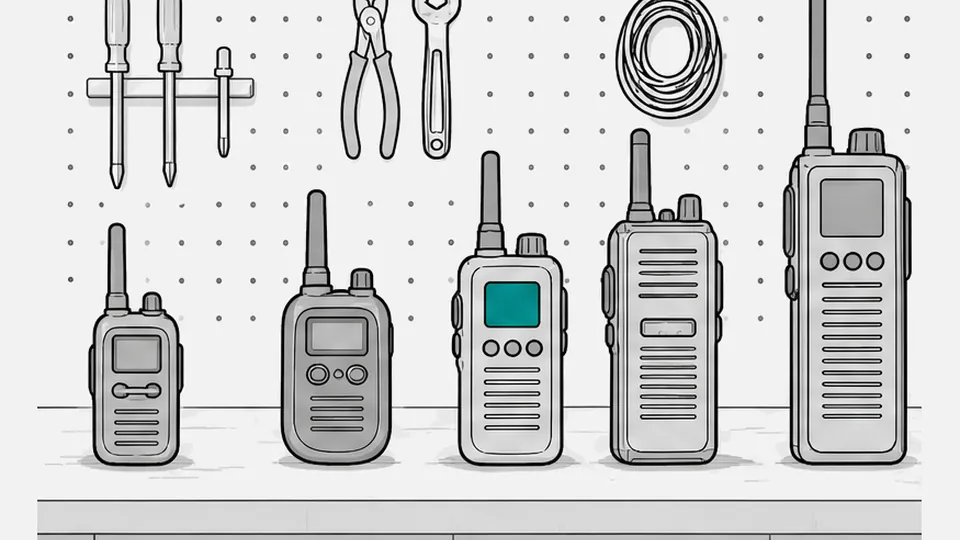
Business radios use antennas you can swap. Kenwood lists separate VHF and UHF antennas for its NX-1000 radios.13
Power: how strongly the radio sends
More power gives more range and uses more battery, Midland says.8 The law sets the cap for each kind of radio.
| Radio | Power limit |
|---|---|
| FRS hand-held, channels 1-7 and 15-22 | 2 W ERP14 |
| FRS hand-held, channels 8-14 | 0.5 W ERP14 |
| PMR446 hand-held | 0.5 W ERP3 |
| GMRS hand-held, channels 1-7 | 5 W ERP15 |
| GMRS car radio or repeater, main channels | 50 W output15 |
ERP, effective radiated power, is the power that leaves the antenna. Licensed business hand-helds such as the Kenwood NX-1200 and NX-1300 send up to 5 W.13
Many radios let you pick a lower setting to save the battery. On the Motorola T800, the top of the PTT button sends on high power and the lower part, marked L, on low.2 How far each class reaches in real places is in longest-range walkie-talkies.
Analog and digital voice
An analog radio sends a copy of the sound wave itself, as FM. A digital radio first turns your voice into a stream of data, then sends the data.6
DMR is the common open digital standard. It fits two talk paths, called time slots, into one 12.5 kHz channel.16 DMR Tier I is the license-free version for the 446 MHz band, and Tiers II and III are for licensed radios.16
Analog and digital radios talk only when the digital radio switches to analog. The Kenwood NX-1000 series lists a digital and analog mixed mode for this.13 What changes in daily use is in DMR vs analog radio.
Repeaters: a relay on a hill
A repeater is a fixed radio placed high up. It listens on one frequency and sends what it hears on another, at higher power. On GMRS, your radio sends to the repeater on a 467 MHz channel. The repeater passes the call on to everyone on 462 MHz, at up to 50 W.1715 Midland says repeater channels use different receive and transmit frequencies and can extend the range of its GXT67 PRO.8
Questions
What is a walkie-talkie?
A hand-held radio that both sends and receives, switched by a push-to-talk button.21 It talks directly to other radios on the same channel, with no phone network.3
Why can't I talk and listen at the same time on a walkie-talkie?
The PTT button switches the radio between sending and receiving. While you hold it, the radio sends; when you let go, it listens.21
What is CTCSS on a walkie-talkie?
A low tone, from 67.0 Hz to 250.3 Hz, sent under your voice. A radio set to the same tone opens its speaker; other calls stay muted.89
What is DCS on a walkie-talkie?
Digitally coded squelch: a digital code sent with your voice in place of a tone. The Midland GXT67 PRO offers 104 of them.83
Do walkie-talkies need cell service or Wi-Fi?
No. A walkie-talkie sends its signal straight to the other radio.3 Phone apps that act like walkie-talkies, such as Walkie Talkie in Microsoft Teams, need Wi-Fi or cellular data instead.18
What is Walkie Talkie on Teams?
A push-to-talk app inside Microsoft Teams for Android and iOS. It works over Wi-Fi or cellular data and uses about 20 Kb/s while sending or receiving audio.18
Sources
- NX-1000 series user manual · Kenwood
- Talkabout T800/T801 series user guide · Motorola Solutions
- 47 CFR 95.563, FRS channels · eCFR
- Speed of light in vacuum · NIST
- GXT67 PRO owner's manual · Midland
- Talkabout T82/T82 Extreme owner's manual · Motorola Solutions
Show all 18 sources
- How to use privacy codes on your Rocky Talkie · Rocky Talkie
- NX-1000 series specification sheet · Kenwood
- DMR standard · DMR Association
- Manage the Walkie Talkie app in Microsoft Teams · Microsoft