Walkie-talkie lingo: the words and what they mean
A walkie-talkie is not a phone. Only one person talks at a time, and the sound is rougher. Radio words fix both problems. They tell the other side when to speak, and they stay clear through noise.
| Word | Meaning | Example |
|---|---|---|
| Over | I have finished, your turn to talk2 | "Are you at the car? Over." |
| Out | I have finished, no reply needed2 | "See you at six. Out." |
| Roger | I received and understood your message2 | "Meet at gate B." "Roger." |
| Copy, do you copy? | I heard you; did you hear me?3 | "Do you copy? Over." |
| Wilco | I understood and I will do it1 | "Bring the cooler." "Wilco." |
| Say again | Repeat what you just said1 | "Say again the time. Over." |
| Go ahead | I am listening, start talking4 | "Go ahead, Sam. Over." |
| Wait | I need a few seconds, keep the channel free1 | "Wait." |
| Stand by | I am busy and will come back to you34 | "Stand by, parking the car." |
| Affirmative, negative | Yes and no, which are easy to lose in noise23 | "Gate open?" "Negative." |
| Correction | I made a mistake, here is the right version2 | "Room 12, correction, room 14." |
| Disregard | Ignore what I just said3 | "Disregard the last message." |
| Radio check | How well do you hear me?2 | "Radio check. Over." |
| Loud and clear | I hear you well3 | "Loud and clear. Over." |
| What's your 20? | Where are you?3 | "Jo, what's your 20? Over." |
| Break break | I have an urgent message and must interrupt2 | "Break break, stop the lift." |
"Roger" and "wilco" do not go together. Wilco already includes roger, so "roger wilco" says the same thing twice.1
"Over and out" is popular in films, and it mixes two endings. "Over" asks for a reply and "out" says none is coming. Pick one.14
Some radios do the "over" for you. Motorola Talkabout radios can send a short beep when you release the button, and Motorola describes it as the same as saying "roger" or "over".11
How to talk on a walkie-talkie: call, reply, finish
Every radio conversation has the same shape. You call, the other person answers, you give the message, and the caller closes. Day Wireless calls it tossing the talk back and forth like a tennis ball.4
- Listen first. Wait until the channel is quiet.4
- Call by name. Say who you call, then who you are: "Mia, this is Dad. Over."34
- Wait for the answer. The other side says "Go ahead" when they are ready.4
- Give one short message. Press the button, wait a beat, then speak. Talking too soon cuts off the first word.4
- Confirm. The listener says "Copy" or repeats the key detail, such as the place or the time.14
- Close. The person who started the call ends it with "Out".4
Speak at a normal pace, with your mouth about 2 in (5 cm) from the microphone. Shouting only distorts the voice.4 The buttons, channels and microphone tips for each radio are in how to use a walkie-talkie.
Walkie-talkie call signs and code names
A call sign is the name you use on the channel. Families use first names. Work teams call by unit or role, such as "Unit three to unit ten" or "Gate to Crane".4 A role stays the same when the person changes. Pick names that sound different from each other, and agree on them before you set off.
Walkie-talkie conversation examples
Here are three short talks on a shared channel. Each one uses the words from the table above.
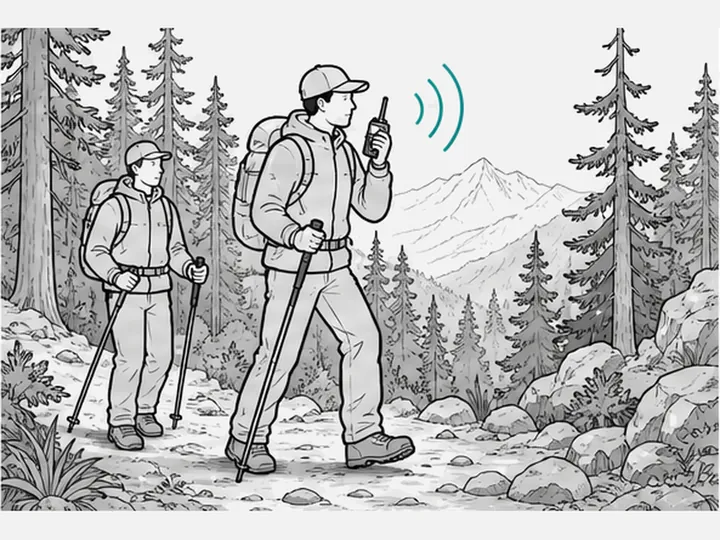
Family hike: meeting at a trail sign
- Dad: Mia, this is Dad. Over.
- Mia: Go ahead, Dad. Over.
- Dad: We are at the bridge. Wait for us at the next trail sign. Over.
- Mia: Copy, waiting at the next trail sign. Over.
- Dad: Thanks. Out.
Mia repeats the place, so Dad knows the message arrived whole. A pair of kids' walkie-talkies works the same way.
Ski group: lunch at a mountain hut
- Anna: Ski group, this is Anna. Radio check. Over.
- Tom: Anna, Tom. Loud and clear. Over.
- Anna: Lunch at Alpina hut, twelve thirty. Over.
- Tom: Say again the hut name. Over.
- Anna: I spell: Alfa Lima Papa India November Alfa. Alpina. Over.
- Tom: Copy, Alpina hut, twelve thirty. Over.
- Anna: Correct. Out.
Wind and gloves make names hard to catch, so Anna spells the name with the phonetic alphabet below.
Work site: a delivery to bay two
- Gate: Crane, this is Gate. Over.
- Crane: Gate, go ahead. Over.
- Gate: Concrete truck arrives in ten minutes at bay two. Over.
- Crane: Wait. … Bay two is clear in five minutes. Wilco. Over.
- Gate: Roger. Out.
If someone needs the channel for safety, they say "Break break" and everyone else stops talking.2 More on work radios is in business two-way radios.
Walkie-talkie codes: what 10-codes mean
10-codes are short number codes from US police radio. APCO, the Association of Public-Safety Communications Officials, set up the familiar 10-codes in 1937.6 The codes cut the length of each call on crowded police channels.7 APCO included a standard set in its Project 2 manual in 1967 and revised it in Project 14 in 1974.6
Two published lists show how the codes compare:
| Code | Tucson Police | Vermont list |
|---|---|---|
| 10-1 | Receiving poorly | Unable to copy, change location |
| 10-2 | Loud and clear | Signals good |
| 10-4 | Message received, OK | Acknowledgement |
| 10-7 | Out of service | Out of service |
| 10-8 | In service | In service |
| 10-9 | Repeat message | Repeat |
| 10-10 | Available for calls | Fight in progress |
| 10-20 | Location | Location |
| 10-23 | At the scene | Arrived at scene |
| 10-33 | Disturbance | Emergency |
Sources: Tucson Police Department9 and a Vermont radio code list10.
The table shows the problem. 10-10 means "available" in Tucson and "fight in progress" in Vermont. A US Homeland Security guide gives a sharper case: 10-88 means "present phone number" in one agency and "officer needs help" in another.7
That is why US responders switched to plain words when several agencies work together. A National Incident Management System alert of December 2006 asks for plain language at multi-agency events.8 APCO itself says plain speech is preferred over 10-codes.8 Inside one agency, 10-codes are still allowed.8
For a family or a work crew, plain words do the same job. "10-4" is widely understood as "OK",9 and "What's your 20?" means "Where are you?".3 Everything else is clearer in ordinary English.
"Walkie-talkie codes" can also mean privacy codes, the tone numbers that open your speaker only for your group. Those are a radio setting, and they are explained in channels and privacy codes.
NATO phonetic alphabet for spelling on the radio
The phonetic alphabet gives each letter a word that sounds unlike any other. The table is set by the ITU in the Radio Regulations, and NATO forces use the same one.51 Say "I spell" before you spell a word, and say the word again after it.1
| Letter | Code word | Say it as |
|---|---|---|
| A | Alfa | AL-fah |
| B | Bravo | BRAH-voh |
| C | Charlie | CHAR-lee |
| D | Delta | DELL-tah |
| E | Echo | ECK-oh |
| F | Foxtrot | FOKS-trot |
| G | Golf | golf |
| H | Hotel | hoh-TELL |
| I | India | IN-dee-ah |
| J | Juliett | JEW-lee-ett |
| K | Kilo | KEY-loh |
| L | Lima | LEE-mah |
| M | Mike | mike |
| N | November | no-VEM-ber |
| O | Oscar | OSS-cah |
| P | Papa | pah-PAH |
| Q | Quebec | keh-BECK |
| R | Romeo | ROW-me-oh |
| S | Sierra | see-AIR-rah |
| T | Tango | TANG-go |
| U | Uniform | YOU-nee-form |
| V | Victor | VIK-tah |
| W | Whiskey | WISS-key |
| X | X-ray | ECKS-ray |
| Y | Yankee | YANG-key |
| Z | Zulu | ZOO-loo |
Numbers on the radio: say each digit
In a clear signal you can say numbers as you normally do. When the signal is poor, say each digit on its own: "channel one four" and not "channel fourteen". Military procedure warns the listener first with the word "figures".1
Some digits get a changed sound, so each one stays distinct on a noisy channel:1
| Digit | Say it as | Digit | Say it as |
|---|---|---|---|
| 1 | wun | 6 | six |
| 2 | too | 7 | sev-en |
| 3 | tree | 8 | ait |
| 4 | fow-er | 9 | nine-er |
| 5 | fife | 0 | zero |
Times work the same way: 16:30 becomes "one six three zero".1 Ships may also use the ITU figure words, such as "Nadazero" for 0 and "Unaone" for 1.5
Walkie-talkie etiquette: rules for a shared channel
A licence-free channel is shared with strangers, and anyone with a radio or a scanner can listen.4 These rules keep it usable for everyone:
- Listen before you talk. Only one person can transmit, so check that the channel is quiet.4
- Wait a beat after you press the button. Then the first word goes through.4
- Say who you call. Name the person first, then yourself.3
- Keep it short. One message per call, then release the button so others can talk.4
- Answer every call to you, even with a single "Copy".4
- Use one ending. "Over" or "Out", never both.4
- Keep it clean and private. No swearing, and nothing you would not say in a public place. US rules ban profane language and malicious interference on these channels.4
- Give way to safety. Messages about safety go first, and "Break break" clears the channel for them.24
Work teams add one more rule: the person who opened the call closes it.4
Questions
What does 10-4 mean on a walkie-talkie?
10-4 means "message received" or "OK". It comes from the 10-codes that APCO set up for US police radio in 1937. Other 10-codes change meaning between agencies, so plain words are safer.6910
Is "over and out" correct?
Pick one of the two. "Over" means you expect a reply. "Out" means the conversation is finished.14
What does "copy" mean on a radio?
"Copy" means "I heard you". "Do you copy?" asks whether the other person hears you. It means the same as "roger".23
Sources
- ACP 125(G) Radio Telephone Procedures, November 2016 · Combined Communications Electronics Board
- Procedure words in radio communications · Tait Communications
- Walkie-talkie lingo: sound like a pro · Midland
- Radio Protocol and Etiquette · Day Wireless Systems
- Radio Regulations, Volume 2, Appendix 14: phonetic alphabet and figure code (2008 edition) · International Telecommunication Union
- APCO's Project Series · APCO International
- Plain Language Guide: making the transition from ten codes to plain language · US Department of Homeland Security, SAFECOM
- Plain Language Frequently Asked Questions, June 2010 · US Department of Homeland Security, Office of Emergency Communications
- Radio Signal Codes, "10 Codes" · City of Tucson Police Department
- Radio codes list · Office of the Defender General, State of Vermont
Show all 11 sources
- Talkabout T800/T801 series user guide · Motorola Solutions