Two-way radio types compared
A type of two-way radio is defined by three things: its band, its signal and its license. This guide compares 19 types in six families, from license-free walkie-talkies to public safety networks. Two radios can talk only when the band, the protocol and the channel match.
Pick any two types below to see their bands, power and channels side by side, and whether the pair can talk.
Compare two radio types
Pick two kinds of radio: see how they differ and whether they can talk to each other.
Radio types by family
The tiles show all 19 types, colored by family. Each family has its own section below.
License-free radios: PMR446, FRS, MURS, CB and LPD
License-free types need no individual license for the user. Eight types sit in this family, all low-power sets for a site, a trail or a campsite.
| Type | Band | Channels and spacing | Power | Who uses it |
|---|---|---|---|---|
| PMR446 analog (EU, UK) | 446.0-446.2 MHz | 16 channels, 12.5 kHz1 | 0.5 W ERP2 | People on one site, at an event or on a trail |
| DMR446, digital PMR446 (EU, UK) | 446.0-446.2 MHz | 16 channels, 12.5 kHz, TDMA1 | 0.5 W ERP | Small businesses that want license-free digital |
| dPMR446, digital PMR446 (EU, UK) | 446.0-446.2 MHz | 32 channels, 6.25 kHz, FDMA1 | 0.5 W ERP | Users who want digital audio and short messages |
| FRS (US, Canada) | 462.550-462.725 and 467.5625-467.7125 MHz | 22 channels, 12.5 kHz3 | 2 W ERP, 0.5 W on channels 8-144 | Individuals, families, groups, recreation and business |
| MURS (US) | 151.820-151.940 and 154.570-154.600 MHz | 5 channels, 11.25 or 20 kHz wide5 | 2 W5 | Personal and business users |
| CB 27 MHz (US, Canada, EU, UK, Australia) | 26.965-27.405 MHz | 40 channels, 10 kHz6 | 4 W AM/FM, 12 W PEP SSB6 | Personal use; business use allowed in the US and Canada |
| LPD433 (EU, UK, Australia) | 433.05-434.79 MHz | 69 channels as sold, 25 kHz7 | 10 mW ERP in the UK8 | Short-range voice where the band allows it |
| UHF CB (Australia) | 476.425-477.4125 MHz | 80 channels at 12.5 kHz or 40 at 25 kHz9 | 5 W | Work teams and the general public |
PMR446 is the European and UK service. Radios are hand-portable with an integral antenna, and repeaters are not allowed.2 Digital PMR446 comes in two standards, DMR Tier I and dPMR, and they do not decode each other.1 Examples: Motorola TALKABOUT T42, Kenwood ProTalk PKT-23, Hytera BD505LF (DMR446), Kenwood ProTalk Digital TK-3701D (dPMR446).10111213 Channel numbers and tones are in walkie-talkie channels and privacy codes.
FRS has no repeater channels, and MURS prohibits repeaters and signal boosters.1415 An example FRS line is the Motorola Talkabout T800.16 PMR446 is not a US service: 446 MHz sits inside the US 70 cm amateur band.17
LPD433 is not one harmonized service but use of the 433 MHz short-range band, so rules differ by country.8 The Midland XT50 PRO carries 69 LPD channels and 16 PMR446 channels as two separate systems.7
PMR446 is exempt from an individual license under the CEPT decision and in the UK, and FRS and MURS are authorized by rule in the US.2818 For the country view, see do you need a license for a walkie-talkie.
GMRS: a family license with more power
GMRS shares the 462 and 467 MHz channels with FRS and adds power, repeaters and a license. It has 30 channels, 16 main and 14 interstitial, and all 22 FRS channels are also GMRS channels.19
Hand-held power is 5 W ERP on the 462 MHz interstitial channels 1-7 and 0.5 W ERP on the 467 MHz interstitial channels 8-14. Mobile, repeater and base stations may use up to 50 W transmitter output on main channels.20 Repeaters transmit on the 462 MHz main channels, and hand-helds reach them on the paired 467 MHz repeater-input channels.19
The license is individual, for people 18 or older, with no exam, and one license covers the licensee's immediate family.21 A GMRS station may talk with FRS units.22 Coded messages are barred, but "10 codes" are allowed.23 Examples: Midland GXT1000 and Rocky Talkie Expedition Radio (5 W).2425 More in FRS and GMRS walkie-talkies.
Licensed business radios: analog, DMR, dPMR and NXDN
Business radios work on frequencies assigned to the user, and the license sets the power.26 Five types sit here.
| Type | Band | Spacing and access | Example lines |
|---|---|---|---|
| Business analog FM | The standard covers 30-1,000 MHz; typical VHF 136-174 and UHF 400-470 MHz2728 | 12.5, 20 or 25 kHz | Motorola CLS1410, Icom IC-F1000 series |
| DMR Tier II (conventional) | 66-960 MHz29 | 12.5 kHz, 2-slot TDMA30 | Motorola MOTOTRBO R2, R5, R7, CP100d; Hytera PD405 |
| DMR Tier III (trunked) | 66-960 MHz | 12.5 kHz, 2-slot TDMA, a controller assigns channels | Motorola MOTOTRBO R7 and DP4000e; Kenwood NX-5200 (optional) |
| dPMR (Modes 1, 2, 3) | Licensed land mobile bands below 1,000 MHz31 | 6.25 kHz, FDMA | Icom IC-F52D and IC-F62D28 |
| NXDN | VHF and UHF business bands | 6.25 or 12.5 kHz, FDMA32 | Kenwood NX-1300 and NX-5200; Icom IC-F52D and IC-F62D |
US analog business systems must use 12.5 kHz channels.33 DMR comes in three tiers: Tier I is the license-free DMR446 variant, Tier II is conventional, and Tier III is trunked.30 DMR encryption is optional and vendor-defined: the DMR Association lists ARC4, DES, AES-128 and AES-256.34
The US Industrial/Business Pool takes companies, schools, clinics and clergy groups, and needs no exam.35 The UK Simple UK Light license allows hand-held or mobile radios at 5 W ERP on shared frequencies, and no base stations.36 Germany takes conventional digital business radio as an application for DMR Tier II or dPMR.37
Public safety radios: TETRA and P25
TETRA and P25 are built for agencies and networks. Access runs through an agency, a network provider or a system license.
| Type | Band | Channels | Modulation and access | Who uses it |
|---|---|---|---|---|
| TETRA | 380-400, 410-430, 450-470, 870-876 and 915-921 MHz38 | 25 kHz carrier, 4 time slots39 | pi/4-DQPSK, 36 kbit/s per carrier, TDMA | Public safety, transport, utilities, governments, armed forces, industry |
| P25 | VHF 138-174, UHF 380-512, 700/800 MHz 764-869 (public safety bands)40 | 12.5 kHz | Phase 1: C4FM, FDMA. Phase 2: 2-slot TDMA | Public safety agencies, utilities, airports, transit |
More than 120 countries run dedicated TETRA networks.41 Europe designates 380-385 and 390-395 MHz for narrowband public safety.42 Terminals work in trunked mode through the network or in direct mode without a base station. Example lines are the Motorola MTP850 S and the Sepura STP9000.4344
P25 started in the US as a public safety standard. Phase 1 is used in conventional and trunked systems, and Phase 2 is for trunking only. AES and DES encryption are part of the suite.4033 Example lines are the Motorola APX 4000, 6000 and 8000, and the Kenwood NX-5200 with a P25 license key.4546
Amateur (ham) radios: FM and digital voice
Amateur radio is a licensed service with an exam, and business traffic is prohibited. The US classes are Technician, General and Amateur Extra, and the UK has Foundation, Intermediate and Full, with 25 W, 100 W and up to 1,000 W PEP.4748 Messages encoded to hide their meaning are prohibited.49
Amateur FM works on the 2 m and 70 cm bands. In the US that is 144-148 and 420-450 MHz, and in Europe 144-146 and 430-440 MHz.17 Band plans set channels and repeater offsets instead of fixed national channels.50 Example line: Yaesu FT-8900R.51
Digital voice comes in three systems. D-STAR uses GMSK in 6 kHz or less. System Fusion uses C4FM and keeps analog FM.5253 Amateur DMR is standard DMR on amateur bands.30 They do not decode each other on air.5253 An example line is the Yaesu FT-70DR, a System Fusion hand-held.54
Marine VHF radios
Marine VHF uses 156.025-162.025 MHz with 25 kHz channels and FM voice. Ship-to-ship traffic uses single-frequency channels, and ship-to-shore traffic uses duplex pairs through coast stations.55 Channel 16 (156.800 MHz) is the distress, safety and calling channel, and channel 70 (156.525 MHz) carries digital selective calling.55
In the US a ship station gets 25 W, reducible to 1 W.56 A ship not covered by carriage rules is licensed by rule, and other stations need an FCC license.57 Channel tables differ by country. A marine radio talks only to other marine radios on the same channel.
Analog vs digital radios
Analog radios send FM voice. Digital radios send symbols, and the protocol decides channel width and access method.
| System | Channel width | Access | Modulation |
|---|---|---|---|
| Analog FM (PMR446, FRS, business FM) | 12.5 kHz; business 12.5, 20 or 25 kHz | Plain FM; no access method named | FM (angle modulation)27 |
| DMR | 12.5 kHz | TDMA, 2 slots | 4FSK, 4,800 symbols/s30 |
| dPMR and dPMR446 | 6.25 kHz | FDMA | 4FSK, 2,400 symbols/s58 |
| NXDN | 6.25 or 12.5 kHz | FDMA | 4FSK32 |
| P25 Phase 1 and Phase 2 | 12.5 kHz | FDMA, 2-slot TDMA | Phase 1: C4FM, 4,800 baud40 |
| TETRA | 25 kHz | TDMA, 4 slots | pi/4-DQPSK, 36 kbit/s per carrier39 |
The CEPT decision names short messages among the reasons to allow digital PMR446.2 On analog PMR446, CTCSS tones and DCS codes only filter what a radio plays, so a radio with the codes off hears everything.2
A digital-only radio does not decode analog FM, and an analog radio does not decode digital. Only a radio with both modes can cross over, one mode at a time.59 The details are in DMR vs analog radio.
Which radio types can talk to each other
Radios of one type talk across brands when the channel, the tone and the mode match. DMR radios built to ETSI TS 102 361-1 interoperate across brands on the same frequency, color code and slot.30 Between types, the table gives the answer. A pair that is not listed cannot talk.
| Pair | Talk? | How, or why not |
|---|---|---|
| FRS and GMRS | Yes | Same channel 1-22 and the same code, or codes off. The GMRS user needs a license. FRS radios cannot use the 467 MHz repeater-input channels, so they cannot use GMRS repeaters.3142221 |
| PMR446 and dPMR446 | Partial | A dPMR446 radio with an analog mode, set to analog, talks to analog PMR446 radios on the same channel and code. The Kenwood ProTalk Digital TK-3701D has it. In digital mode the two cannot talk.13 |
| PMR446 and DMR446 | Depends on the model | Only a DMR446 radio with an analog mode could. The Hytera BD505LF page lists analog specifications but does not describe mode switching, so check the manual of the exact model.12 |
| dPMR446 and licensed dPMR | Not on PMR446 | Both follow the dPMR standard: 6.25 kHz FDMA. A licensed radio may not be used on PMR446 channels, so the two do not share a channel.583160 |
| DMR Tier II and business analog | Partial | A DMR radio with an analog mode, set to an analog channel, on the same frequency and code. A mixed-mode repeater can serve both.5961 |
| DMR Tier III and business analog | Partial | A Tier III-capable radio switched to a conventional analog channel. Not on the trunked system itself.59 |
| NXDN and business analog | Partial | An NXDN radio with analog enabled receives analog and digital conventional signals and replies in the mode it received. Conventional channels only.62 |
| dPMR and business analog | Partial | A dPMR radio with an analog mode on a conventional analog channel.62 |
| P25 and business analog | Partial | Analog support is mandatory in Phase 1 radios and optional in Phase 2, so check the model. Conventional operation only.33 |
| P25 Phase 1 and Phase 2 | Partial | A Phase 2 radio works with Phase 1 radios and systems, not the other way round.40 |
| Amateur DMR and business DMR | Partial | Both are standard DMR, so on the same frequency, color code and slot they decode each other. Each license covers only its own frequencies, so in practice they do not share any.3049 |
| System Fusion and amateur analog FM | Partial | A Fusion radio set to analog FM, or to Auto Mode Select, talks to analog FM radios. In digital mode the analog radio cannot decode it.53 |
| DMR446 and dPMR446 | No | Same band, different protocol: 12.5 kHz TDMA against 6.25 kHz FDMA.1 |
| DMR Tier II and DMR446 (Tier I) | No | ETSI states there is no interoperability across the tiers. Licensed radios may not be used on PMR446.3060 |
| DMR Tier II and Tier III | No | The same holds even when one radio supports both tiers.30 |
| NXDN and dPMR | No | Icom offers them as separate protocol choices on the same 6.25 kHz FDMA design, and a radio runs one or the other.62 |
| NXDN and DMR | No | NXDN is FDMA, DMR is 2-slot TDMA. Kenwood sells one model as NXDN or DMR by suffix, and the NX-5200 runs several, but they do not decode each other.326346 |
| D-STAR, System Fusion and amateur DMR | No | Different modulation and framing. Linking needs an internet gateway or a cross-mode hotspot.525364 |
| PMR446 and FRS or GMRS | No | 446 MHz against 462 and 467 MHz.23 |
| PMR446 and LPD433 | No | 446.0-446.2 MHz against 433.05-434.79 MHz.72 |
CB, UHF CB, MURS, LPD433, marine VHF and TETRA talk only to their own type. CB needs the same mode as well (AM, FM or SSB), and UHF CB the same channel plan (25 kHz or 12.5 kHz).9 Four rules explain every "no" in the table:
- Different band. The two types share no frequency, so the radios cannot hear each other.
- Different protocol. Both are digital but built to different standards, so even on one frequency they cannot decode each other.
- Different DMR tier. Tier I, Tier II and Tier III do not work across each other.
- Analog against digital. A digital-only radio does not decode analog FM.
How to link different radio types
A bridge joins types that cannot talk by themselves. Each keeps its own license and rules.
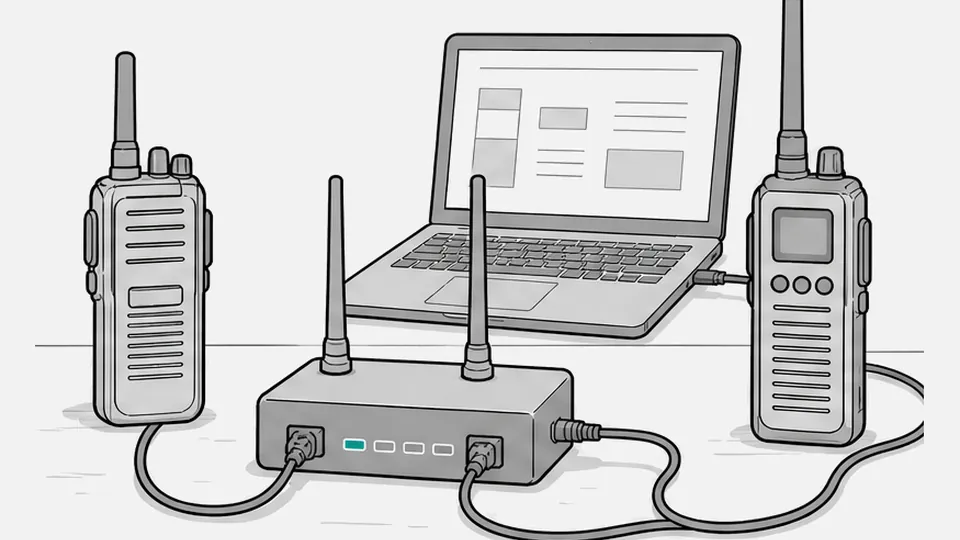
- Dual-mode radios. One radio has an analog and a digital mode, picked per channel. It does not relay between modes. Examples: Motorola MOTOTRBO CP100d, Kenwood ProTalk Digital TK-3701D.5913
- Mixed-mode repeaters. A repeater runs analog, digital or both, so a fleet can move to digital in steps. Example: Motorola MOTOTRBO SLR 8000, which needs a repeater license.61 Yaesu System Fusion repeaters do the same on amateur bands.53
- Multi-protocol radios. The Kenwood NEXEDGE NX-5200 runs any two of NXDN, DMR and P25 at once, plus FM analog. It joins each system but does not convert calls between them.46
- Radio-over-IP gateways. A box joins radio channels of different types to each other, to SIP phones, to LTE radios and to push-to-talk apps. Examples: Icom VE-PG4 and the Raven FlexGate, which Zello lists as tested. The license must allow a network connection.6566
- P25 and TETRA interfaces. P25 connects analog fixed stations through AFSI, and ISSI links separate P25 networks.4067 The TETRA Inter-System Interface links two TETRA networks, and 3GPP interworking links mission-critical LTE with TETRA and P25.6869
- Cross-band repeat. A dual-band FM radio such as the Yaesu FT-8900R receives on one band and re-transmits on another, so a VHF hand-held reaches a UHF one. It needs a repeater license and is not allowed on PMR446, MURS or FRS.5121514 Amateur use follows 47 CFR 97.205 in the US.50
- Internet links. The Free Radio Network (FRN) connects CB, PMR and LPD radios through a PC interface to an internet room. Its article names eQSO 446 as the earlier network; that story is in the eQSO history. The CEPT decision bars PMR446 equipment from acting as a repeater or as part of an infrastructure network. Australia's CB class license explicitly allows internet links for CB.7029
- Amateur cross-mode gateways. Hotspot software such as WPSD links amateur digital modes. DMR2YSF puts DMR radios into System Fusion rooms.64
Questions
What are the main types of two-way radio?
Six families: license-free, GMRS, licensed business, public safety, amateur and marine VHF. Inside them the signal is analog FM or a digital protocol.24055
Can a PMR446 walkie-talkie talk to a DMR radio?
Not in digital mode. A DMR446 radio reaches an analog PMR446 radio only with an analog mode, so check the manual of the exact model. A licensed DMR Tier II radio cannot join: tiers do not work across each other, and licensed radios may not be used on PMR446.301260
Can FRS and GMRS radios talk to each other?
Yes. All 22 FRS channels are GMRS channels, so the same channel and code put them on one frequency. Only the GMRS user needs a license.322
Do I need a license?
It depends on the type. PMR446, FRS, MURS, CB, LPD433 and UHF CB need none where allowed. GMRS needs a license without an exam, business radio a license or permit, and amateur radio an exam. See do you need a license for a walkie-talkie.213547
What is the difference between a walkie-talkie and a two-way radio?
On this site, "two-way radio" is the broad term for every type above, and "walkie-talkie" is the everyday word for the hand-held sets.
Sources
- 47 CFR 95.563: FRS channels · eCFR
- Midland XT50 PRO manual (PMR446 and LPD) · Midland
- Radiocommunications (Citizen Band Radio Stations) Class Licence 2025 · Australian Government
- TALKABOUT T42 (PMR446) · Motorola Solutions
Show all 71 sources
- ProTalk PKT-23E (PMR446) · Kenwood Communications UK
- BD505LF license-free DMR radio · Hytera
- ProTalk Digital PMR446 (dPMR446, digital and analogue) · Kenwood Communications UK
- Talkabout T800 (FRS) · Motorola Solutions
- GXT1000VP4 GMRS two-pack · Midland
- Expedition Radio (5 W GMRS) · Rocky Talkie
- MOTOTRBO R7 data sheet · Motorola Solutions
- IC-F52D/F62D IDAS handheld (NXDN, dPMR) · Icom America
- DMR standards (tiers, 66-960 MHz) · DMR Association
- NXDN professional digital radio protocol · JVCKENWOOD
- P25 FAQ v1.5 (2018) · Project 25 Technology Interest Group
- Key benefits of DMR (encryption options) · DMR Association
- Betriebsfunk: notes for application forms (DMR Tier II / dPMR) · Bundesnetzagentur
- Statement of P25 User Needs (Aug 2020) · CISA P25 Steering Committee
- MTP850 TETRA terminal · Motorola Solutions
- STP9000 TETRA radio · Sepura
- APX 6000 (P25) portable radio · Motorola Solutions
- NEXEDGE NX-5000 portable spec sheet · Kenwood
- What is System Fusion · Yaesu
- FT-70DR System Fusion handheld · Yaesu
- VHF marine channel table · US Coast Guard NAVCEN
- MOTOTRBO CP100d series (analog and digital modes) · Motorola Solutions
- PMR446 (Latvia) · Elektroniskie sakari
- MOTOTRBO SLR 8000 repeater (mixed mode analog/digital) · Motorola Solutions
- IDAS solutions (NXDN and dPMR) · Icom America
- NX-1200/NX-1300 brochure · Kenwood
- DMR2YSF cross-mode · WPSD manual
- VE-PG4 RoIP gateway · Icom America
- Radio gateways tested with Zello · Zello
- Benefits of Project 25 (2010) · Project 25 Technology Interest Group
- HM785 DMR mobile radio · Hytera