VHF vs UHF: the two bands side by side
VHF means very high frequency, and UHF means ultra high frequency. The ITU sets the bands: VHF runs from 30 to 300 MHz, and UHF from 300 to 3,000 MHz.1 Two-way radios use only a small part of each.
| VHF | UHF | |
|---|---|---|
| ITU band | 30-300 MHz1 | 300-3,000 MHz1 |
| Band used by business hand-helds | 136-174 MHz23 | 400-520 MHz23 |
| Wavelength at a typical radio frequency | About 2 m at 150 MHz4 | About 65 cm at 460 MHz4 |
| Antenna | Typically longer5 | Typically shorter5 |
| Strong where | Open land, farms, forests5 | Buildings, warehouses, cities5 |
Motorola Solutions sums it up in one line each. VHF signals typically travel farther in open areas with few obstacles. UHF gets through walls and concrete better.5 The rest of this page explains why, and where the rule bends.
VHF and UHF frequency ranges by service
Every kind of walkie-talkie sits in one band or the other. The license-free radios sold for families are all UHF. Type a frequency or a channel below to see which service and band it belongs to.
What is on this frequency?
Type a frequency or a channel. You see which radio service it belongs to, where you can use it and which radios use it.
How a radio turns your voice into a signal on these frequencies is in how walkie-talkies work.
| Service | Frequencies | Band |
|---|---|---|
| CB radio | 26.965-27.405 MHz6 | HF, below VHF |
| Business radio, US | 150-170 MHz7 | VHF |
| MURS, US | 151.820-154.600 MHz8 | VHF |
| Marine radio | 156-162 MHz9 | VHF |
| Ham 2 m band, US | 144-148 MHz10 | VHF |
| Ham 70 cm band, US | 420-450 MHz10 | UHF |
| PMR446, Europe and UK | 446.0-446.2 MHz11 | UHF |
| Business radio, US | 450-470 MHz7 | UHF |
| FRS and GMRS, US | 462.5500-467.7250 MHz1213 | UHF |
So a US family with FRS or GMRS radios, or a European family with PMR446, is already on UHF. MURS is the one license-free US walkie-talkie service on VHF. Its five channels are covered in MURS frequencies.
Some UHF radios also listen to VHF. The Midland GXT67 PRO receives NOAA weather broadcasts on 162.400-162.550 MHz, a VHF band, though it sends only on GMRS.14
Boat radios use VHF. Channel 16, 156.800 MHz, is the international distress, safety and calling frequency, and channel 9, 156.450 MHz, is a calling channel for recreational boats.15
Wavelength and antenna length
A radio wave's length is the speed of light divided by its frequency. At 150 MHz one wave is about 2.0 m long; at 460 MHz it is about 65 cm.4 That is why VHF is "metric waves" in the ITU table, and UHF "decimetric waves".1
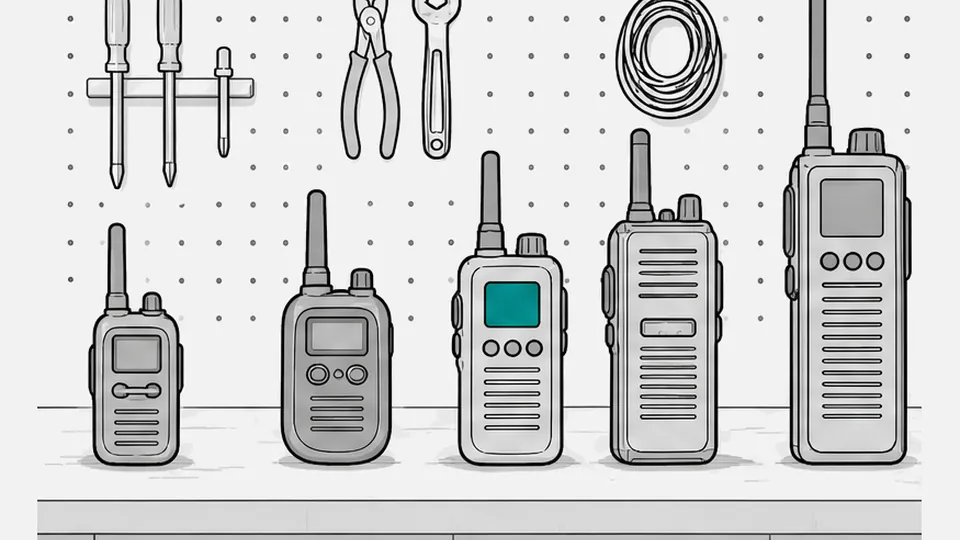
The simplest antenna, a whip, is a quarter of a wave long. That comes to about 50 cm at 150 MHz and 16 cm at 460 MHz.4 Motorola notes that VHF radios typically carry longer antennas, and longer antennas may be less practical to carry.5
Makers shrink VHF antennas to fit a belt. Kenwood's NX-1000 accessories include a VHF helical antenna, a wire coiled into a short stub, next to a UHF whip.2 A short antenna on a long wave gives up some strength, so a VHF hand-held with a stub antenna loses part of its band's natural lead.
VHF vs UHF range: what really sets the distance
Height and the radio horizon
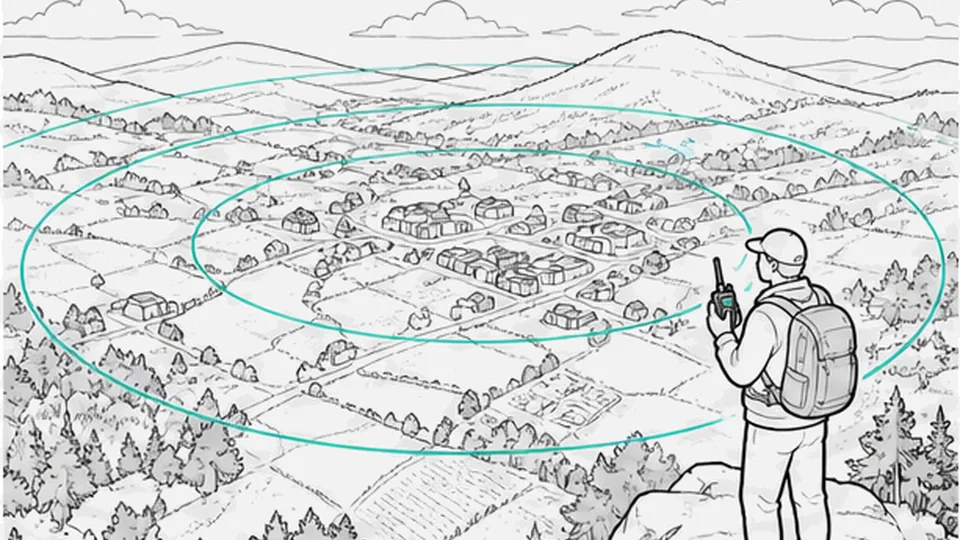
At these frequencies a signal needs a fairly clear line between the two antennas. Radio waves bend a little in the air, and the ITU's standard figure for that bending is k = 4/3.16 With it, an antenna at head height (1.5 m) sees about 5 km to the radio horizon. One on a 10 m mast sees about 13 km.16
So height matters more than band. A base station on a tall mast sees far beyond the horizon of a hand-held at head height.
Two hand-helds at head height
Between two hand-helds held at head height, the band matters less than the horizon, the ground and what stands in the way. Two things eat VHF's natural lead at this height: the short antenna, and electrical noise. The longer VHF reach that Motorola describes shows up with a long antenna placed high.5 Think of a car roof, a boat mast or a base station.
Real distances for hand-helds in the open, in forests and in towns are in longest-range walkie-talkies, with a range estimator for your own place.
Electrical noise in towns
Engines, power lines and machines give off radio noise, and VHF hears more of it. The ITU's noise model puts city noise at 150 MHz about 16.5 dB, or 45 times, above the basic hiss every receiver hears. The level falls as the frequency rises.17 A VHF radio in a busy town has to pick your call out of that noise.
Open water
Water is flat, so the horizon sets the limit. A ship's VHF radio may send up to 25 W, far more than a 2 W FRS hand-held.1819 Its antenna sits on a mast, where it sees well past the 5 km horizon of a radio held at head height.16
A hand-held marine radio held at head height faces the same 5 km horizon as any other hand-held.16 That is why boats keep a fixed radio with a mast antenna.
Getting into buildings
For an ordinary building, the ITU model gives almost the same median loss on both bands. It is about 14 dB at 150 MHz and at 446 MHz.20 The gap opens in modern, energy-efficient buildings with metal-coated glass and foil-backed panels. There the median loss is about 37 dB at 150 MHz and 33 dB at 446 MHz.20 That gap of 4.7 dB means about three times more UHF signal gets inside.
Which to pick: VHF or UHF for your site
Motorola lists the sites where each band fits.5 Two more rows come from the rules for license-free radios and for boats.
| Site | Band | Why |
|---|---|---|
| Warehouse or distribution center | UHF | Gets through walls and concrete better5 |
| Building site, hotel, school, hospital | UHF | Suits buildings and dense city blocks5 |
| Farm, ranch, forestry crew | VHF | Covers wide, open or wooded land5 |
| Utility crew on remote lines | VHF | Remote outdoor sites5 |
| Family ski trip or hike | UHF | FRS, GMRS and PMR446 are all UHF1112 |
| Boat | VHF | Marine channels sit at 156-162 MHz9 |
A mixed site, such as a farm with large barns, comes down to where people spend most of their day. Motorola names terrain, building density and distance as the deciding factors.5
For families, the choice is made already: every license-free walkie-talkie in FRS and GMRS walkie-talkies is UHF. For a team, business radios often come in a VHF and a UHF version, so order the band your site needs. Kenwood sells the NX-1200 for VHF and the NX-1300 for UHF.2
VHF and UHF radios cannot talk to each other
A radio sends and listens only inside its own band. The Kenwood NX-1200 covers 136-174 MHz, and its twin, the NX-1300, covers 400-470 MHz.2 Kenwood builds both on one platform, yet they never hear each other. An FRS radio may not transmit on any frequency outside its 22 channels.21
So every radio in a team must be on the same band. Multi-band radios exist for public safety. The Motorola APX 8000 covers VHF, UHF and 700/800 MHz in one radio.3 The radio type compatibility tool checks any pair of radio types.
VHF and UHF licenses
The license depends on the service, not the band. In the US, FRS and MURS run without an individual license, while GMRS needs one.2223 Business radios on VHF or UHF need an FCC Industrial/Business Pool license.7 Rules for other countries are in do you need a license for a walkie-talkie.
Questions
What does UHF stand for?
Ultra high frequency: 300 to 3,000 MHz in the ITU table. VHF, very high frequency, is 30 to 300 MHz.1
Which goes farther, VHF or UHF?
Motorola says VHF travels farther in open areas and UHF works better through buildings.5 VHF's lead shows with a long antenna placed high; between two hand-helds at head height, the horizon of about 5 km limits both.16
Can a VHF radio talk to a UHF radio?
No. Each radio sends and listens only in its own band. The VHF Kenwood NX-1200 covers 136-174 MHz, and the UHF NX-1300 covers 400-470 MHz.2
Are walkie-talkies VHF or UHF?
Most consumer walkie-talkies are UHF: FRS and GMRS at 462-467 MHz and PMR446 at 446 MHz. MURS radios in the US are VHF, at 151-154 MHz.81112
What is the VHF emergency frequency?
For boats, channel 16, 156.800 MHz. It is the international distress, safety and calling frequency.15
Sources
- NX-1000 series specification sheet · Kenwood
- APX 8000 all-band P25 portable radio data sheet · Motorola Solutions
- Speed of light in vacuum · NIST
- UHF vs. VHF radios: understanding the differences · Motorola Solutions
Show all 23 sources
- 47 CFR 95.563, FRS channels · eCFR
- GXT67 PRO owner's manual · Midland