MURS frequencies: the full chart
MURS, the Multi-Use Radio Service, is a US radio service for short-distance talk or data. The FCC opened it to the general public, for personal or business use.1 It has five channels, all on VHF, near 151 and 154 MHz.2
The chart shows each MURS frequency with its power limit and channel width. It numbers the channels 1-5 in frequency order. The FCC rule lists the frequencies only, so radios may number them in their own way.2
| Ch | MHz | Power | Width |
|---|---|---|---|
| 1 | 151.820 | 2 W | 11.25 kHz |
| 2 | 151.880 | 2 W | 11.25 kHz |
| 3 | 151.940 | 2 W | 11.25 kHz |
| 4 | 154.570 | 2 W | 20.0 kHz |
| 5 | 154.600 | 2 W | 20.0 kHz |
Every MURS radio must be built to transmit on one or more of these five frequencies.2 A transmitter certified for MURS cannot also be certified for another Part 95 service, such as FRS or GMRS.3 So a MURS radio talks on MURS only.
Type a frequency or a channel to see which service it belongs to and where it is legal. "MURS 4" or "154.570" both work.
What is on this frequency?
Type a frequency or a channel. You see which radio service it belongs to, where you can use it and which radios use it.
MURS channels by group: width and power
The five channels fall into two groups. They differ in how wide a signal may be.4
| Channels | Frequencies, MHz | Widest signal allowed | Power limit |
|---|---|---|---|
| 1-3 | 151.820, 151.880, 151.940 | 11.25 kHz | 2 W transmitter output |
| 4-5 | 154.570, 154.600 | 20 kHz | 2 W transmitter output |
Width means how much of the band one signal may fill. A narrow signal fits the 151 MHz channels. On the two 154 MHz channels, a radio may use a wide signal.4 The BTECH MURS-V2 lets you choose the width on the 154 MHz channels only. Its screen shows an N when the narrow setting is on.5 Set the same width on every radio in your group for the clearest sound.
The 2 W limit counts power at the radio's output, before the antenna.6 FRS counts its 2 W at the antenna, as effective radiated power (ERP).7 MURS also allows a fixed outside antenna, such as one on a roof or a mast, within the height limit below.8
MURS channel numbers on radios
Makers number the five frequencies themselves, so the number on the screen is the maker's choice. Match radios by frequency first.2
The BTECH MURS-V2 comes set with 15 MURS channels in three banks of five. Channel 1 is "MURS1-1" on 151.820 MHz, and channel 6 is "MURS2-1" on the same frequency.5 You can set a privacy code and the power level on each of them.5 Motorola's RMM2050 works on the 5 MURS frequencies and offers 219 PL/DPL codes.9
PL and DPL are Motorola's names for privacy codes. A privacy code is a quiet tone or digital code that opens the speaker only for radios set to the same code. The FCC allows these tones on MURS voice channels.10 Two radios must share the frequency and the code to hear each other. More on codes is in walkie-talkie channels and privacy codes.
Voice modes on MURS
The rule allows both AM and FM voice, plus several kinds of data signal.10 The BTECH MURS-V2 sends analog FM, listed as 16K2F3E (wideband) on its spec sheet.11 A signal that wide, 16.2 kHz, fits only the 20 kHz channels 4 and 5.4
MURS rules: license, repeaters, antenna and data
MURS runs without an individual license. The FCC authorizes Personal Radio Services by rule, unless a service's own subpart asks for a license.12 The MURS subpart has no license requirement, and a business may use MURS too.1
| Rule | What it means | FCC section |
|---|---|---|
| No repeaters | A MURS radio may not relay other signals. Signal boosters and store-and-forward packet links are banned too.13 | 95.2733 |
| Antenna height | The top of the antenna stays within 60 ft (18.3 m) of the ground, or 20 ft (6.1 m) above the building or mast it sits on.8 | 95.2741 |
| Voice, data and images | MURS may carry voice, data or pictures, plus remote-control and sensor signals.14 | 95.2731 |
| No constant carrier | A radio may not stay on the air nonstop with a constant signal.1015 | 95.2757 |
| No phone link | A MURS radio may not connect to the public phone network.16 | 95.2749 |
| Not in the air | MURS is not allowed aboard an aircraft in flight.17 | 95.2707 |
| Listen first | Check that the channel is free before you talk.18 | 95.2725 |
| Repairs | You may replace a damaged antenna with a similar type, and batteries with the type the maker names.19 | 95.2719 |
Telecommand means a remote-control signal. Telemetry means readings sent from a sensor, such as one on a gate or a water tank. Both are allowed on MURS.14
A base antenna near an airport has extra height limits. The FCC rule sets them by distance from the nearest runway.20
Only certified radios may be used on MURS, as in every Personal Radio Service.21 A radio that tunes to 151.820 MHz but lacks MURS certification does not qualify.
Where MURS came from
Before MURS, these five frequencies were licensed under Part 90, the FCC's rules for business and public safety radio. Stations licensed there on November 13, 2000 may keep running under their old terms.22 Canada's regulator notes that MURS radios have been in use in the US since 2002.23
How to set up MURS radios for a group
Every radio in the group needs the same three settings: frequency, width and code. Then the radios hear each other.
- Pick one frequency. Choose one of the five and find its number in each radio's chart.25
- Match the width on channels 4 and 5. On 154.570 and 154.600 MHz, set every radio to the same width.45
- Match the privacy code. Set the same code on every radio, or switch codes off on all of them.10
- Listen before you talk. The FCC asks MURS users to check that the channel is free first.18
- Use low power up close. The MURS-V2 offers 0.5 W and 2 W. A key switches a low-power channel to high power for a while when a call does not get through.5
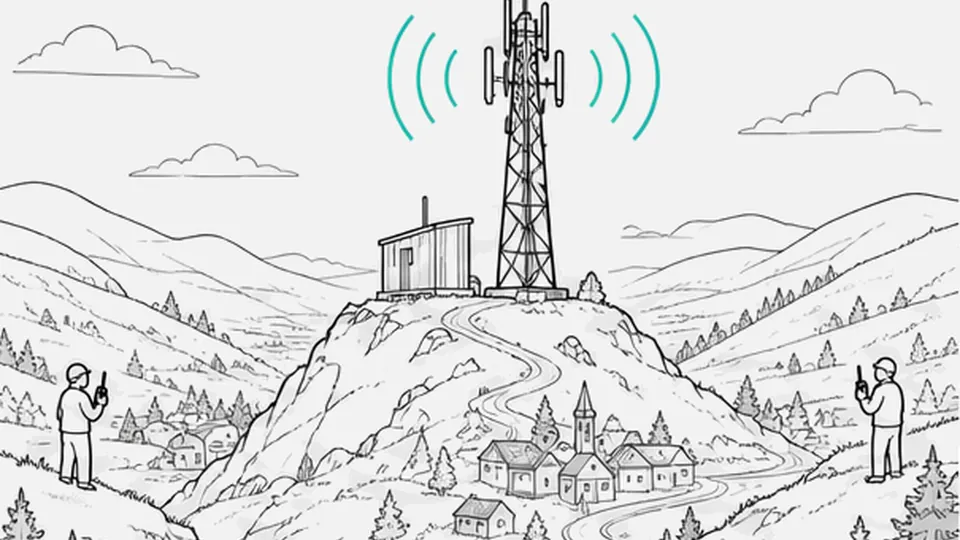
- Mount a base antenna within the limit. Keep its top within 60 ft of the ground or 20 ft above the roof.8
Motorola sells the RMM2050 in its on-site business radio line, and BTECH pitches the MURS-V2 for warehouses and other open spaces.911
MURS vs FRS and GMRS
MURS sits next to FRS and GMRS, the two US walkie-talkie services on UHF. It is the only one of the three on VHF.224
| MURS | FRS | GMRS | |
|---|---|---|---|
| Band | VHF, 151.820-154.600 MHz2 | UHF, 462-467 MHz24 | UHF, 462-467 MHz25 |
| Channels | 52 | 2224 | 3025 |
| Power | 2 W output6 | 2 W ERP, 0.5 W on 8-147 | Up to 50 W on main channels26 |
| License | None12 | None12 | FCC license27 |
| Repeaters | Not allowed13 | No repeater channels28 | Allowed25 |
A MURS radio cannot talk to an FRS or GMRS radio. They work on different bands, and each certified radio stays inside its own service.23 Mixed groups need a second radio for each person, or one service for everyone.
BTECH says VHF channels carry farther in open spaces than the UHF channels of FRS and GMRS.11 The longer answer, with buildings and hills, is in VHF vs UHF radio. FRS and GMRS channels are set out in FRS and GMRS walkie-talkies and GMRS frequencies.
MURS radios: what the makers list
Two makers' own pages give these figures for their MURS radios.
| Radio | MURS channels | Power | Privacy codes | Maker's range claim |
|---|---|---|---|---|
| Motorola RMM2050 | 5 MURS frequencies9 | 2 W9 | 219 PL/DPL9 | Up to 220,000 sq ft or 13 floors9 |
| BTECH MURS-V2 | 15 preset MURS channels in 3 banks5 | 2 W or 0.5 W5 | 50 CTCSS tones, 346 DCS codes5 | 0.5-2 mi in neighborhoods, warehouses or woods, 3-5+ mi in clear line of sight29 |
Motorola adds that coverage varies with terrain, conditions and radio model.9 The BTECH radio also receives NOAA weather channels and works as a scanner on other VHF and UHF frequencies.529
MURS outside the US
MURS is a US service. FCC rules cover the US and its territories. They also cover US-registered boats, at home or in international waters, with the captain's permission. In another country, that country's rules apply.30
In Canada, the MURS frequencies belong to licensed users, including public safety services. For MURS-style devices, Canada set aside five 462 MHz frequencies called GMRS-M. They serve gear such as dog trackers and intercoms.23
In Europe, the license-free walkie-talkie band is PMR446, at 446 MHz. Its channels are on PMR446 frequencies. Germany adds a small VHF band for handhelds at 149.01875-149.11875 MHz. It allows 1 W ERP, no repeaters, and runs until 30 September 2035.31 Other countries are in the license checker.
Questions
What are the MURS frequencies?
151.820, 151.880, 151.940, 154.570 and 154.600 MHz. The first three are 11.25 kHz wide and the last two are 20 kHz wide.24
What frequency is MURS channel 1?
The FCC rule has no channel numbers. On the BTECH MURS-V2, channel 1 is 151.820 MHz, so check the chart in your radio's manual.25
Do you need a license for MURS?
No. MURS is authorized by rule in the US, for personal and business use, at up to 2 W.1216
Can MURS use repeaters?
No. Repeaters, signal boosters and store-and-forward packet links are banned on MURS.13
Can MURS radios talk to FRS or GMRS radios?
No. MURS is on VHF near 151-154 MHz, while FRS and GMRS are on UHF near 462-467 MHz.224
Is MURS legal in Canada?
No. The MURS frequencies serve licensed users in Canada, and Canada uses GMRS-M on 462 MHz instead.23
Sources
- MURS-V2 user manual · BTECH
- RMM2050 two-way radio · Motorola Solutions
Show all 31 sources
- MURS-V2 specification sheet · BTECH
- SP 462/467 MHz, licence-exempt devices, Issue 2 · Innovation, Science and Economic Development Canada
- 47 CFR 95.563, FRS channels · eCFR
- Allgemeinzuteilung 149.01875-149.11875 MHz, Vfg. 45/2025 · Bundesnetzagentur