Business two-way radio systems: three ways to set up
There are three ways to set up business radios. License-free radios need no paperwork, and licensed radios give you your own channel and more power. A repeater or trunked system covers a bigger site and more people.
Pick your country to see which radio services need a license there.
Which radios need a license?
Pick a country: every kind of radio is listed with whether you can use it freely, need a license, or may not use it there.
| Set-up | Paperwork | Hand-held power | Fits |
|---|---|---|---|
| License-free radios | None | PMR446 in Europe: 0.5 W1. FRS in the US: 2 W, and 0.5 W on channels 8 to 142 | One building, a shop, a school, an event |
| Licensed radios | A business license | 5 W on VHF and 4 W on UHF for the Motorola R73 | A large site, noisy places, several buildings close together |
| Repeater or trunked system | A license, plus one for the repeater | Same hand-helds, with a repeater lifting the signal | A campus, a warehouse yard, a venue with many teams |
License-free business radios
License-free radios are the easiest start. In Europe they are PMR446 radios, with 16 channels and a built-in antenna.1 Business use is allowed, and the Motorola XT420 is sold as a business radio with no subscription or call charges.4
In the US, FRS radios need no license and business use is allowed.5 MURS has five VHF channels, also with no license and business use allowed, but no repeaters.6 Motorola sells the DTR700 as a license-free business radio on 900 MHz.7
The trade-off is sharing. Everyone can use these channels, and France's regulator says such radios get no protection from interference.8 If you need clean channels, go licensed.
Licensed radios on your own frequency
A license gives you a channel for your business and more power. The Motorola R7, for example, is rated at 5 W on VHF and 4 W on UHF, up to ten times the 0.5 W of PMR446.13
Two kinds of channel exist. A shared frequency is cheaper, and other licensed users may be on it too.
An exclusive area frequency costs more. In the Netherlands, for example, a shared-frequency license for VHF and UHF radios costs 271 euros once and 102 euros a year, and an individually planned frequency costs 1,061 euros once, then 507 euros a year per base station and 102 euros a year per license.9
Some countries make it simple. The UK Business Radio Simple UK Light license covers hand-helds and mobiles at 5 W ERP on 19 shared frequencies, with no base stations.10 The US Industrial/Business Pool takes companies, schools, clinics and clergy groups.11
Radios through a repeater or trunked system
A repeater is a box on a roof or a high spot. It hears your call and sends it again, so hand-helds reach much farther. License-free PMR446 does not allow repeaters, so this set-up is always licensed.1
A trunked system goes further. It shares a pool of channels among all users, and the system picks a free channel for each call.
In DMR this is called Tier III.12 Motorola says its Capacity Plus trunking serves up to 1,000 users on one site.13
To join several buildings, Motorola's IP Site Connect links sites over the internet.13 A trunking license costs more. The Dutch regulator charges 1,061 euros once per base station, then 1,238 euros a year per frequency and site, up to 3,712 euros a year per frequency.9
What you need to set up a radio system
You need five things.
Radios. One for each person who talks, plus a few spares. Pick them by the set-up above.
Chargers. A desktop charger, or a multi-unit charger for a group of radios. The Hytera PD405 comes with a desktop charger and lists multi-unit chargers as options.14
Earpieces. Quiet jobs, such as security, often suit a receive-only earpiece. Hytera lists receive-only earpieces, earsets with an in-line microphone and remote speaker microphones for the PD405.14
A license, if you use licensed channels. The license section below lists six countries.
Programming. Business radios are programmed with the maker's software through a cable, which sets channels, groups and preset messages.14 Motorola's XT420 uses an HTML-based programming tool.4
How to size your radio system
Start with the teams. List who needs to talk to whom, such as the front desk, the kitchen and security. Give each busy team its own channel or talk group.
Radios hold plenty. The Motorola R2 holds 64 channels, and the Hytera PD405 holds 48 channels in 3 zones.1514 PMR446 has 16.1
DMR gives two talk paths on one channel, and the DMR vs analog guide explains how.
Then measure the site. Note the longest distance between two people, the number of floors and the thickness of the walls. Use the tool below to see the distance most calls get through.
How far will my radios reach?
Pick your radios and where you use them. You get the distance most calls get through, standing at head height.
If a license-free radio covers your longest walk, stay license-free. If not, move to a licensed radio such as the 5 W R7. If you have several buildings or a large yard, add a repeater.
Business two-way radios by set-up
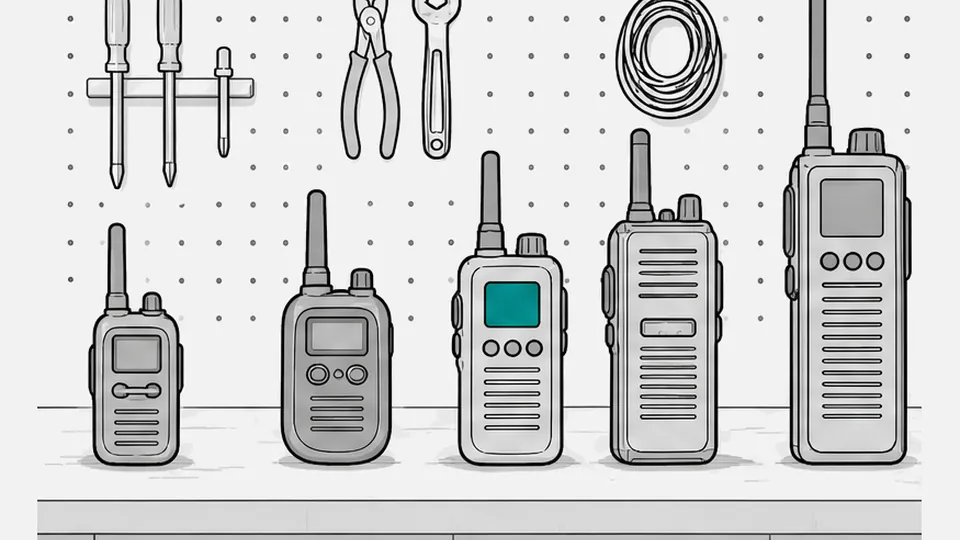
The first table shows radios sold in Europe: two license-free PMR446 radios, then licensed radios that run analog and DMR. The R7 adds trunked DMR for larger systems.3 Prices are dealer prices with the month.
| Radio | Power | Water and dust | Approx. price |
|---|---|---|---|
| Motorola XT460 | 0.5 W | IP55 | ≈ €168 single · Oct 2026 |
| Hytera BD505LF | 0.5 W | IP54 | ≈ €186 single · Oct 2026 |
| Motorola MOTOTRBO SL1600 | 3 W | IP54 | ≈ €492 single · Oct 2026 |
| Hytera HP605 | 5 W | IP68 | ≈ €550 single · Oct 2026 |
| Motorola MOTOTRBO R7 | 5 W | IP68 | ≈ €966 single · Oct 2026 |
The second table shows radios for the US market. The CLS1410 is an analog business radio, the CP100d runs analog and DMR, the DTR700 is the license-free 900 MHz radio and the R5 runs analog and DMR Tier II.
| Radio | Power | Water and dust | Approx. price |
|---|---|---|---|
| Motorola CLS1410 | 1 W | IP5X / IPX2 | ≈ $203 single · Oct 2026 |
| Motorola MOTOTRBO CP100d | 5 W | IP54 | ≈ $277–394 single · Oct 2026 |
| Motorola DTR700 | 1 W | IP54 | ≈ $472–622 single · Oct 2026 |
| Motorola MOTOTRBO R5 | 5 W | IP67 | ≈ $769 single · Oct 2026 |
License for business radios by country
A business license is a license for a company, a site or a number of radios. Here are six countries. The license page covers all the others.
| Country | Business radio license | What the regulator says |
|---|---|---|
| US | Part 90 Industrial/Business Pool | Companies, schools, clinics and clergy groups are eligible11 |
| UK | Business Radio Simple UK Light | 5 W ERP, 19 shared frequencies, no base stations, 75 pounds for 5 years10 |
| Canada | Land mobile radio license | About 4.25 dollars a month per mobile and 12.14 dollars a month per metro base frequency16 |
| Germany | Individual frequency assignment | A one-time fee plus a yearly frequency contribution17 |
| Netherlands | Shared or individual frequency | 271 euros once and 102 euros a year for a shared frequency9 |
| France | Individual authorization, shared-use option | 17 simplex and 5 duplex channels, yearly fees, no protection from interference18 |
Push-to-talk over cellular for wide areas
If your team works across a whole city or country, push-to-talk over cellular is the other option: a phone or a radio-shaped device talks through the mobile network instead of radio channels, so there is no radio license and the range is wherever the network reaches.
Questions
What is a two way radio system for business?
A set of radios on shared channels, plus whatever extends them: a license, chargers, programming and, for bigger sites, a repeater. There are three set-ups: license-free radios, licensed radios, and radios through a repeater or trunked system.1313
Do business two way radios need a license?
Not always. PMR446 in Europe and FRS and MURS in the US need none and allow business use.156 Licensed business channels need a license in nearly every country; the checker above shows each one.1110
How does a walkie talkie work for a team?
Radios set to the same channel hear each other. Press the button to talk and release it to listen. A repeater, if you have one, hears the call and sends it again so it reaches farther.
How far do commercial two way radios reach?
It depends on the place. The Motorola R7 is rated at 5 W on VHF against 0.5 W for PMR446, which helps in big buildings.13 Use the range estimator above for your site.
Which system suits a warehouse?
One building with clear aisles can run license-free or licensed single-channel radios. A yard or several buildings need a repeater; many sites use IP Site Connect to link them.13
What do I need besides the radios?
Chargers, earpieces, a license for licensed channels and programming software and a cable.14
Sources
- MOTOTRBO R7 data sheet (EMEA) · Motorola Solutions
- XT420 business two-way radio · Motorola Solutions
- DTR700 digital two-way radio · Motorola Solutions
- Tarieven landmobiele communicatie · Rijksinspectie Digitale Infrastructuur
Show all 18 sources
- The DMR standards, developed by ETSI · DMR Association
- MOTOTRBO SLR 8000 repeater · Motorola Solutions
- MOTOTRBO R2 data sheet (EMEA) · Motorola Solutions
- RIC-42 Guide for calculating radio licence fees · ISED Canada
- Betriebs- und Bündelfunk · Bundesnetzagentur