eQSO and FRN: walkie-talkies on the internet
eQSO and the Free Radio Network (FRN) are two programs that connect a walkie-talkie to the internet. Two people in different cities could talk on license-free radios, because a PC at each end passed their voices along. Both programs were built for CB and PMR446 radios, among others.12
PMR446 sits at 446 MHz and CB at 27 MHz, so the two radios cannot talk to each other over the air. The comparison shows the difference.
Compare two radio types
Pick two kinds of radio: see how they differ and whether they can talk to each other.
The domain pmr-radio.net hosted an eQSO and PMR gateway project from 2007 to 2018. This page is the history of that kind of link.
How a gateway worked
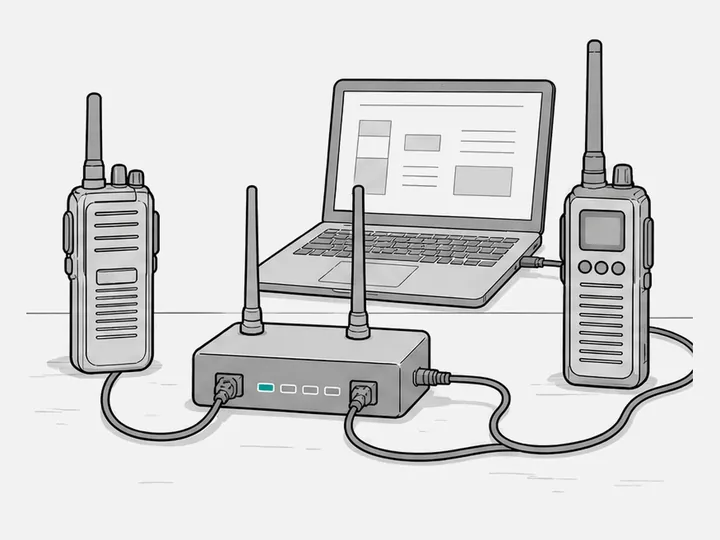
A gateway is a radio, a PC and an interface between them. The radio sits on one channel with one tone. The PC runs the eQSO or FRN program and connects to a server on the internet.34
The interface lowers the radio's speaker signal to the level of the PC's microphone input, and it presses the radio's talk button through a COM or USB port.56 Later interfaces needed only the sound card connections.6
Here is the loop. A handheld near the gateway transmits, the gateway radio hears it and the PC sends the audio to the server. The server passes it to every other gateway and PC user in the room, and each gateway transmits it on its own radio.23
One link station on the Isle of Wight shows the scale. It used a Pentium 3 800 PC, a Telcom TW1000 radio and a homemade keyer, and it served about a two-mile radius around Ryde.3 Radios in that circle used channel 7 with CTCSS tone 19 to use the link.3
Rooms: how the network was organized
Rooms are the key idea. A room is a virtual channel on a server. Whatever one station sends, every station in the room hears, links and repeaters included.2
FRN uses the same idea with its own words. Gateways connect to an FRN server, and a group of connected gateways forms a net. Several nets can run on one server.4
On FRN, users in one area reach people in other cities or countries by choosing the same channel and tone. FRN's own page says CTCSS 20 is the most used tone.4 CTCSS is a quiet tone sent under the voice that opens a speaker only for your group.
PC users could join without any radio. They talked through a microphone.45
eQSO: the earlier network
The author of eQSO is Paul Davies, call sign M0ZPD. A 2003 directory of internet gateways says he developed eQSO around 2001 and released it first to replace older conference servers.2 The program is built around chat rooms where you listen or talk, much like a radio net.2
The same directory says eQSO needed no authorization to use at the time.2 Wikipedia says eQSO was written to link amateur radio gateways and repeaters, and was also developed for license-free radio such as CB, PMR446 and the US Family Radio Service.1 M0ZPD's own download page describes a program for PC users and RF gateways, with separate gateway and server packages.7
By September 2003 the directory noted that gateways had spread to PMR446, with links across the UK and other countries.2
Free Radio Network (FRN)
FRN is a client and server program written by Edwin, a Dutch radio amateur with the call sign PA7FRN. It was made for license-free services: CB, PMR, DMR, SRD and LPD, FRS and Freenet. It later became usable for amateur radio as well.56
A Slovak article from 2020, updated in 2022, rates FRN as a competitor to eQSO. It says the main eQSO servers had long outages, and that FRN asks for a free registration that keeps unwanted users out.8 The article describes a nonstop CB gateway in Bratislava and an occasional PMR gateway in Lučenec on the same server.8
The original FRN software runs on Windows. Independent developers added clients for Linux and FreeBSD, and a Java server that runs on any platform.5 The original monitor server had repeated outages, so in 2016 a developer built an alternative monitor server with its own database.5
| Year | What happened | Source |
|---|---|---|
| 1998 | Ireland first permits license-free PMR446 use on April 1 | Wikipedia9 |
| About 2001 | Paul Davies develops eQSO | Gateway directory2 |
| 2003 | A UK directory notes gateways spreading to PMR446 | Gateway directory2 |
| 2007-2018 | pmr-radio.net hosts an eQSO and PMR gateway project | This site |
| 2016 | Alternative FRN monitor server built | German Wikipedia5 |
| 2020 | Slovak article presents FRN as a competitor to eQSO | cq.sk8 |
Who used the gateways
Walkie-talkie owners used them to reach people beyond the 446 MHz range. A handheld near a gateway could talk to someone in another city or another country, by choosing the same channel and tone.4 The Isle of Wight station asked users not to use it for business and to switch off roger beeps, the short tone some radios send after each call.3
PC users joined from home with a microphone.4 FRN's official site also links to a page for Jamboree On The Air, the scouting radio event.4
CB and PMR hobbyists in Slovakia and the Czech Republic used FRN for links such as a Bratislava to Prague example on PMR channels 8 and 7.8 Amateur radio operators used eQSO to link their own gateways and repeaters.12
PMR446 rules for gateways
PMR446 is a short-range, peer-to-peer service. The CEPT decision ECC/DEC/(15)05 says PMR446 equipment is hand portable, uses an integral antenna and transmits no more than 0.5 W. It also says PMR446 cannot be used as part of an infrastructure network or as a repeater.10
CB rules differ by country. Australia's CB class license explicitly allows carrying CB speech over the internet through a PC, not on CB frequencies.11
What remains today
FRN is still online. Its official site describes VoIP gateways connected to a server and offers a client, with a link to an Android client.4 The German Wikipedia article, last edited in August 2026, describes FRN in the present tense, with Raspberry Pi boards as 24-hour gateways.5
Wikipedia's PMR446 article names eQSO and FRN as examples of PMR446 gateways connected over the internet.9 The decision text above still sets the rules for the radios themselves.
For the radios and channels, see PMR446 walkie-talkies and channels and privacy codes. The radio types are in types of two-way radio.
Questions
What was eQSO?
eQSO was a client and server program from Paul Davies, M0ZPD, developed around 2001. It joined radio gateways and PC users in internet chat rooms.12
What is the Free Radio Network?
FRN is a client and server program by Edwin, PA7FRN, for CB, PMR, DMR, SRD and LPD, FRS and Freenet radios. Gateways connect to a server, and PC users can join with a microphone.45
How does a PMR446 gateway work?
A radio and a PC are joined by an interface. The PC sends what the radio hears to a server, and the server passes it to every other gateway in the room.235
Can PMR446 radios be used as a repeater?
No. ECC/DEC/(15)05 says PMR446 equipment cannot be part of an infrastructure network or a repeater.10
Which tone did FRN users pick?
FRN's site says CTCSS 20 is the most used tone code.4
Was there a PMR gateway project on pmr-radio.net?
Yes. The domain hosted an eQSO and PMR gateway project from 2007 to 2018.
Sources
- eQSO · Wikipedia
- Amateur Radio Internet Gateway Directory and Callbook, September 2003 · Dave Williams, G8PUO, Radio-Ham.org
- Free Radio Network · Free Radio Network
- Free Radio Network · German Wikipedia
- Free Radio Network · Eurofunker
- PMR446 · Wikipedia
Show all 11 sources
- Radiocommunications (Citizen Band Radio Stations) Class Licence 2025 · Australian Government