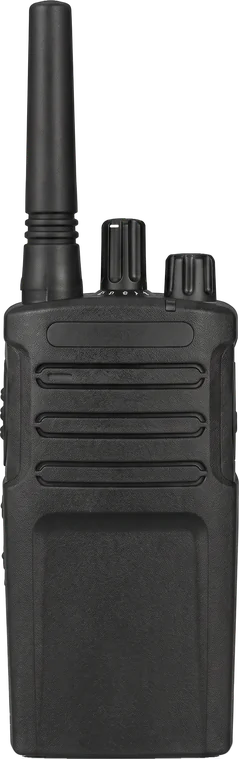
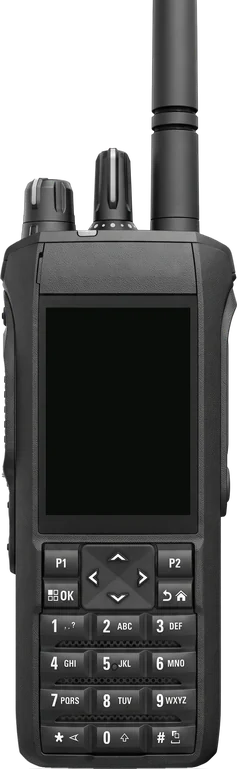
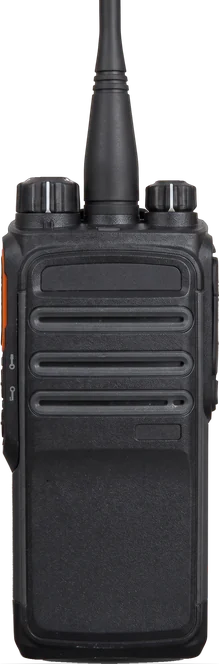
Kenwood PKT-23 at a glance
The PKT-23, also written PKT23, is a pocket radio from Kenwood. This page covers the PKT-23E, the edition for PMR446, the European radio band that needs no license.
It suits staff who carry a radio all day. The one thing to know: Kenwood UK lists it as a discontinued product.
Kenwood files it under license-free PMR446, and the UK page calls it a consumer FM transceiver. The brochure speaks of business use and a tough build.
Who the PKT-23 is for
The PKT-23E suits a shop, a hotel front desk, a small school or an event team. It weighs 110 g and fits a pocket or the included belt clip.
All keys sit on the front panel, so staff learn it in a minute. Kenwood says you can give channels to named team members.
Pick something else in three cases. If you need a display, a loud speaker or a high IP rating, see the Motorola XT420.
If the radio must run on AA or AAA batteries, the sources show a Li-ion pack only, so look at a home radio. For several buildings, a licensed radio such as the Hytera PD405 gives more power.
Kenwood PKT-23 range: the claim and real use
Kenwood gives no range figure for the PKT-23E. The brochure states 500 mW of power and says the radio talks directly to other radios on the same frequency.
The law caps PMR446 at 0.5 W, so regulators give modest numbers. The Latvian regulator expects a few hundred meters in a city and up to a few kilometers in the countryside. CEPT's ECC Report 369 simulates 0.7 to 1.0 km on rural land for 95 percent of connections, and about 0.1 km in a city.
Walls, floors and shelves take range away, so expect less indoors. Kenwood's sensitivity figure uses a 20 dB SINAD test.
Motorola's XT420 sheet uses 12 dB, so the two figures cannot be compared. The range tool estimates your own building.
Kenwood PKT-23 battery and charging
Kenwood claims about 15 hours at a 5/5/90 duty cycle with battery saver on, and 11 hours with it off. That pattern means 5 percent of the time sending, 5 percent listening and 90 percent idle.
The battery is a 1,430 mAh lithium-ion pack, 3.8 V, listed as KNB-71L. Kenwood gives a charge time of 2 hours. The sources describe no AA option.
Charging uses a micro USB port, so a smartphone charger works. The box holds the battery, a KSC-44CR fast charger, a KSC-44SL adapter and a belt clip. The brochure also shows a multi-charger for 6 radios, listed as available later.
To check the level, press the power key briefly while the radio is on. The LED blinks blue 3, 2 or 1 times for high, medium or low.
Channels, privacy codes and which radios it talks to
The PKT-23E offers up to 8 channels on 446.0 to 446.1 MHz with 12.5 kHz spacing. The EU model comes with all 8 PMR446 channels pre-programmed. A voice guide announces the channel when you change it.
| Ch | MHz | Power | Width |
|---|---|---|---|
| 1 | 446.00625 | 0.5 W ERP | 12.5 kHz |
| 2 | 446.01875 | 0.5 W ERP | 12.5 kHz |
| 3 | 446.03125 | 0.5 W ERP | 12.5 kHz |
| 4 | 446.04375 | 0.5 W ERP | 12.5 kHz |
| 5 | 446.05625 | 0.5 W ERP | 12.5 kHz |
| 6 | 446.06875 | 0.5 W ERP | 12.5 kHz |
| 7 | 446.08125 | 0.5 W ERP | 12.5 kHz |
| 8 | 446.09375 | 0.5 W ERP | 12.5 kHz |
| Ch | MHz | Power | Width |
|---|---|---|---|
| 9 | 446.10625 | 0.5 W ERP | 12.5 kHz |
| 10 | 446.11875 | 0.5 W ERP | 12.5 kHz |
| 11 | 446.13125 | 0.5 W ERP | 12.5 kHz |
| 12 | 446.14375 | 0.5 W ERP | 12.5 kHz |
| 13 | 446.15625 | 0.5 W ERP | 12.5 kHz |
| 14 | 446.16875 | 0.5 W ERP | 12.5 kHz |
| 15 | 446.18125 | 0.5 W ERP | 12.5 kHz |
| 16 | 446.19375 | 0.5 W ERP | 12.5 kHz |
The radio supports QT tones and DQT codes. QT is Kenwood's name for CTCSS, a quiet tone that opens the speaker only for your group.
DQT is the digital version. A code keeps other groups' chatter out, but it does not make a call secret.
You can set channel frequencies and codes on the radio itself, with no software. Switch it off, hold PTT and the Up key, and switch it on.
Then use Up and Down to pick the channel. The sources do not list the factory codes or how many codes exist, so check both radios before you rely on a match.
The PKT-23E is analog FM, so it talks to other analog PMR446 radios on the same frequency and code. The Motorola XT420 shares the eight lower channels. The compatibility tool shows which radio types can talk.
Where the PKT-23 is legal
PMR446 is license-free across Europe. An ECC decision tells CEPT countries to exempt the band from individual licenses.
Germany does it through a general assignment and France through a general authorization. The rules allow business use and are the same in each country.
The radio must be hand-held with a built-in antenna and at most 0.5 W ERP, which is the power measured at the antenna. Base stations and repeaters are not allowed. The PKT-23E meets that with 500 mW ERP.
The UK needs one more check. Kenwood UK describes the PKT-23E as the model for EU use outside the UK. The UK allows PMR446 under an Ofcom exemption, so ask the seller how a unit is approved for UK use.
The US has no PMR446 service, because 446 MHz sits inside the US 70 cm amateur band. This page covers only the PKT-23E sold for Europe. See do you need a license for a walkie-talkie for country rules.
Build, water and controls
The PKT-23E is rated IP54. The 5 means dust cannot get in enough to harm the radio.
The 4 means it survives splashing water from any direction. Kenwood also says it meets or exceeds 11 items of Military Standard 810 C to G. It measures 46 by 85 by 21 mm without the antenna.
To switch on, hold the power key for 1 second. You hear a beep and the LED blinks blue for the battery level. Hold it for 2 seconds to switch off.
Hold the PTT key to talk, and release to listen. PTT means push to talk.
PF-2 switches the Up and Down keys between volume and channel. Up and Down then change the one you chose. PF-1 sends a calling alert by default.
That is a tone that tells a colleague to answer. Holding PF-2 for 1 second monitors the channel, so you can listen before you speak.
The LED shows the state. Red means sending, green means receiving, blinking green means scanning and blinking red means a low battery. There is no screen.
A 3.5 mm jack on top takes the KHS-33 earbud headset or the KHS-34 C-ring headset. Kenwood does not supply either one.
Limits of the PKT-23
There is no display and no keypad. You learn the channel by voice and the LED. Kenwood publishes no range, no operating temperature and no release year.
Audio output is lower. The internal speaker is rated 300 mW, and the XT420 sheet gives 1500 mW. In a noisy shop or a loading bay, plan on a headset.
The battery is a Li-ion pack with no AA option in the sources. The sources list no GPS, Bluetooth, emergency button or text messaging. VOX works with an external microphone.
VOX starts sending when it hears your voice, and the gain has 5 levels. Kenwood UK lists the PKT-23E as discontinued, so check stock and spare batteries before you buy a team set.
How the PKT-23 compares
The Motorola XT420 is the business radio of the same band. Motorola claims up to 9 km in line of sight and up to 20 hours at 5/5/90.
It adds IP55, a 1500 mW speaker and 219 codes. It weighs 244 g, more than twice the PKT-23E.
The Midland XT50 PRO is a home radio with PMR446 and LPD, a second band at 433 MHz. Midland says that band can be subject to national restrictions.
Midland claims 8 km and 12 hours, lists IPX2 and accepts 3 AAA batteries. It has the lowest water rating of the four.
The Hytera PD405 is a licensed DMR radio with 4 W on UHF and IP55. Hytera claims 12 hours analog and 16 hours digital at 5/5/90 on the standard pack. It needs a license, and it covers more ground.
| Radio | Claimed range | Claimed battery | Power | Water and dust |
|---|---|---|---|---|
| Kenwood PKT-23 (PKT-23E) | — | 15 h | 0.5 W | IP54 |
| Motorola XT420 | 9 km | 20 h | 0.5 W | IP55 |
| Midland XT50 PRO | 8 km | 12 h | 0.5 W | IPX2 |
| Hytera PD405 | — | 12 h | 5 W | IP55 |
How big is the Kenwood PKT-23 (PKT-23E)?
The Kenwood PKT-23 (PKT-23E) next to other radios, a phone and a bank card, drawn to scale. Pick up to three to compare.
Kenwood PKT-23 (PKT-23E) full specifications
Values come from the maker's pages and manuals listed at the end of the page. Range and battery life are the maker's claims.
| Bands | UHF (446.0-446.1 MHz) |
|---|---|
| Standards | analog |
| Channels | 8 |
| Transmit power | 0.5 W |
| Claimed battery life | 15 h |
|---|---|
| Battery | Li-ion 1430 mAh |
| Charging | Micro USB; KSC-44CR fast charger and KSC-44SL adapter listed |
| Water and dust | IP54 |
|---|---|
| Military standard | MIL-STD-810 C/D/E/F/G |
| Weight | 110 g |
| Size | 46 x 85 x 21 (W x H x D), excluding antenna mm |
Questions
What is the Kenwood PKT-23?
It is a pocket PMR446 radio with 0.5 W and 8 channels. The edition covered here is the PKT-23E for Europe. It weighs 110 g.
Does the Kenwood PKT23 need a license?
No, the PKT-23E uses PMR446, which is license-free in CEPT countries. Business use is allowed. Check the UK rules and approval before you buy.
How long does the PKT-23 battery last?
Kenwood claims about 15 hours at 5/5/90 with battery saver on, and 11 hours with it off. Charging takes 2 hours.
How do I change the channel on the PKT-23?
Press PF-2 to set the Up and Down keys to channel mode. Then press Up or Down, and a voice announces the channel.
Is the Kenwood PKT-23 discontinued?
Kenwood UK lists the PKT-23E as a discontinued product. The sources name no successor.
Sources
- PKT-23E License-Free Analogue PMR446 (Discontinued) · Kenwood Communications UK
- PKT-23 Instruction manual B5A-0647-40 · Kenwood
- ECC/DEC/(15)05, PMR 446 in 446.0-446.2 MHz · CEPT ECC
- UK Interface Requirement 2030 · Ofcom
- Allgemeinzuteilung SRD, Vfg. 91/2025 · Bundesnetzagentur
- ECC Report 369, PMR 446 power increase · CEPT ECC
- PMR446 page · Elektroniskie sakari (Latvia)
Show all 14 sources
- XT400 Series specification sheet (v2 02/19) · Motorola Solutions
- XT50 PRO user's manual · Midland Europe