What certification marks on a walkie-talkie mean
A legal radio carries the approval mark of the country where it is sold. The mark tells you the maker tested the radio against that country's rules for power, frequencies and interference. A radio without the right approval is not allowed to be sold or used in many countries, so the mark is the first thing to look for.1234
The mark is a different thing from a license. A radio can need no license, like a PMR446 set in Europe or an FRS set in the US, and still have to carry an approval mark. License rules are in walkie-talkie license rules.
How to check a walkie-talkie in 3 steps
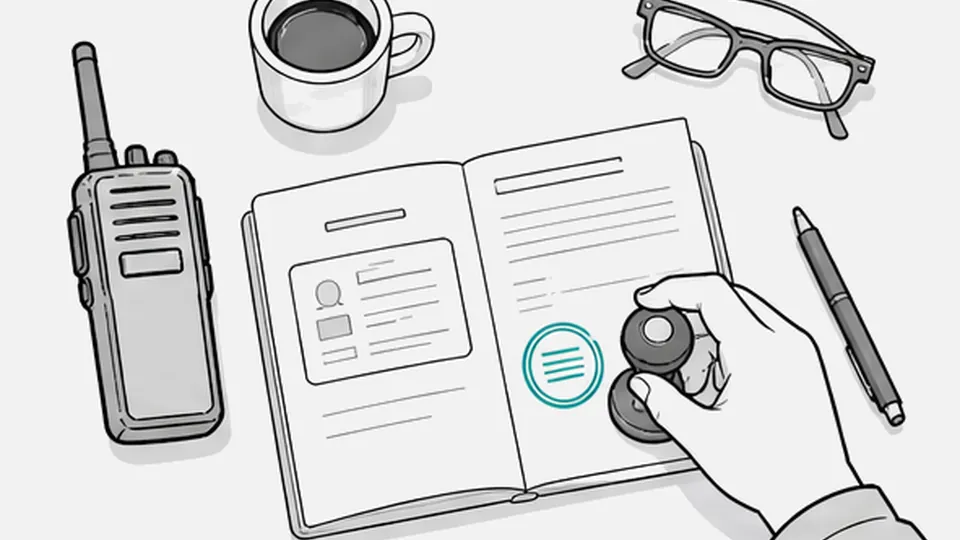
- Find the label. Look on the back of the radio, under the battery, on the box and in the manual. Radios with a screen can also show the mark in a menu.23
- Read the mark or the ID. A CE mark is a logo. An FCC ID, an IC number and an Anatel code are text and numbers, and the label shows them next to the words "FCC ID" or "IC:".56
- Look it up. Type the number into the regulator's database and compare the model name, the frequencies and the power with your radio.
Where to look up the number:
- US: the FCC ID search. An FCC ID is a grantee code, the first three or five characters, followed by a product code. The grant page lists the frequency range, the power and the test reports.57
- Canada: ISED's Radio Equipment List. Search by certification number, then by hardware version number, then by model name.68
- Australia: the supplier of the radio must be registered on the national database before the RCM goes on the product, so ask the shop for the supplier name and the declaration of conformity.9
- EU and UK: the CE mark comes with an EU declaration of conformity, a short document from the maker that names the Radio Equipment Directive.10
Radio approval marks by country
| Country | Mark | What to look for |
|---|---|---|
| EU | CE | The CE logo on the radio or its label, and a declaration of conformity under the Radio Equipment Directive10 |
| UK | UKCA or CE | Either logo is accepted in Great Britain for radio equipment. The UKCA mark may sit on a label or a document until December 31, 20271213 |
| US | FCC ID | The words "FCC ID" and a code on the label. Search the code in the FCC database57 |
| Canada | IC number | A label that reads "IC:" followed by a company number and a product number. Search the Radio Equipment List68 |
| Australia | RCM | The RCM logo, from a supplier registered on the national database9 |
| Japan | Giteki | The Giteki mark (技適マーク). Radios used without a license need it14 |
| Brazil | Anatel | The Anatel seal with a homologation number15 |
| India | WPC ETA | An Equipment Type Approval from the WPC Wing, needed to import, sell and use a wireless device16 |
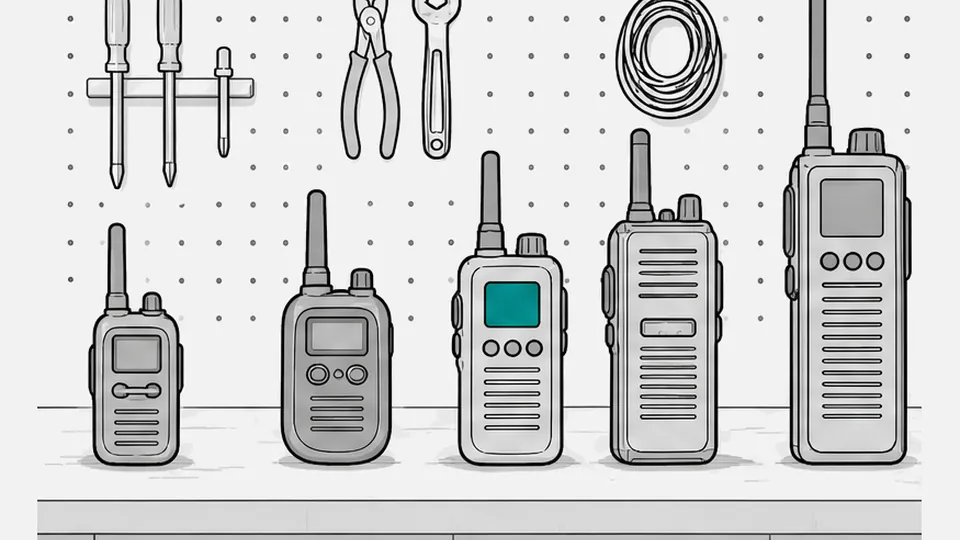
The check in this table is the same for any radio type: analog, DMR or Android PoC. A radio with a cellular modem or Wi-Fi gets more approvals for those parts, so its label can show several marks.
Why a low-cost VHF/UHF radio needs an FCC grant
FRS is a free service in the US, and its radios must be FCC-certified.17 The FCC says many low-cost VHF/UHF radios lack the approval needed to be imported, advertised or sold in the US, because they can be modified to transmit on public-safety and other land-mobile channels.4
The FCC Enforcement Advisory DA 18-980 of September 24, 2018 gives sellers and owners the rules:
- A radio that can transmit outside the amateur bands needs FCC certification and an FCC label.
- A radio that can transmit only on amateur frequencies needs no certification, and its user needs an amateur license.
- Owners of radios without approval "should not use them".
- In 2018 the advisory named penalties of up to $19,639 per day of marketing violations and up to $147,290 for a continuing violation. The current table in 47 CFR 1.80 lists $25,132 and $188,491.418
In practice, a radio that shows no FCC ID on its label calls for a closer look. Check the FCC ID first, then the frequencies in the grant. The details of FRS, GMRS and ham radio are in the license rules page.
FCC ID versus CE: why US and European radios differ
An FCC ID is a US approval. In Europe the matching approval is CE. The two systems are separate, so a US radio is not approved for the EU because it carries an FCC ID, and a European PMR446 radio with a CE mark is not an FCC-approved radio in the US.15
An FCC ID alone is not a Canadian approval either: a radio sold in Canada needs an IC number and an entry on the Radio Equipment List.68 The license page lists the countries and the frequencies, so check it before you pack a radio.
Use the checker to see which services each country allows.
Which radios need a license?
Pick a country: every kind of radio is listed with whether you can use it freely, need a license, or may not use it there.
Walkie-talkies on a trip
Check each destination before you pack. Three rules cover most trips.
- Japan. A radio used without a license in Japan needs the Giteki mark.14 Visitors may use their own radio equipment for up to 90 days, and the rule lists Wi-Fi and Bluetooth devices. In practice, walkie-talkies are not on that list, so a PMR446 or FRS set from home does not fall under it.19
- Brazil. Anatel's service page says telecom products may not be used or sold in Brazil without homologation. A radio from home that has no Anatel number is not approved there.15
- Europe. Take PMR446 radios only where PMR446 is allowed, and check the country in the license rules page first.
Buying a radio at your destination is the simplest route: a shop there sells models carrying that country's mark.
Marks and security rules for connected radios
The CE mark covers more than radio waves. From December 11, 2027, a radio with a data connection, such as Bluetooth, USB programming or LTE, also meets the EU Cyber Resilience Act, and the CE mark covers that too.20 The UK rules for connected radios are in Cyber Resilience Act and walkie-talkies.
In the US, an approved radio from a company on the FCC Covered List has its own rules. They are in FCC Covered List and Hytera radios.
Timeline of the marks
| Date | What happens |
|---|---|
| September 24, 2018 | FCC Enforcement Advisory DA 18-980 on low-cost VHF/UHF radios4 |
| October 1, 2024 | Great Britain keeps accepting CE-marked radio equipment1213 |
| March 1 and June 1, 2027 | Online marketplaces in the US must show a valid FCC ID on listings, first for marketplaces that hold or own the stock and later for pure third-party platforms21 |
| December 11, 2027 | The EU Cyber Resilience Act applies in full20 |
| December 31, 2027 | The period ends in which the UKCA mark may sit on a label or an accompanying document12 |
Dates can move, so check the current text with the regulator.
What certification marks mean for you
- Buyers. Look for the mark and the number before you pay. On an online listing, ask the seller for the FCC ID, the IC number or the declaration of conformity.
- Shops and sellers. Sell radios that carry the mark of your market. In Brazil, platforms share the liability with sellers for products without homologation.22
- Businesses. A fleet bought for several countries is easier to run with one model per region, each with its own mark.
- Travelers. Pack the radio only for countries where its mark and its frequencies match.
Questions
What does the CE mark on a walkie-talkie mean?
The maker declares that the radio meets the EU rules and has a declaration of conformity. The mark is required on radio equipment sold in the EU.1011
How do I check an FCC ID?
Find the "FCC ID" text on the label, then enter the code in the FCC ID search. The grant page shows the frequencies, the power and the test reports.57
Is a UKCA mark or a CE mark needed in the UK?
Either one is accepted in Great Britain for radio equipment.1213
Is a low-cost VHF/UHF radio legal in the US?
A radio that can transmit outside the amateur bands is legal to sell only with FCC certification and a label. A radio that transmits only on amateur frequencies needs no certification, and its user needs an amateur license.4
Sources
- Radio Equipment Directive 2014/53/EU · EUR-Lex
- Radiocommunication Act, section 4 · Justice Laws Website
- RSS-Gen, general requirements for radio apparatus · ISED Canada
- RSP-100, certification of radio apparatus · ISED Canada
- Radiocommunications Equipment (General) Rules 2021 · Federal Register of Legislation
- Radio Equipment Directive (RED) · European Commission
Show all 23 sources
- Radio Act, English translation · Japanese Law Translation
- Equipment Type Approval (ETA) · Department of Telecommunications, India
- Cyber Resilience Act · European Commission
- Regulamento da Anatel formaliza responsabilização solidária de plataformas digitais · Ministry of Communications, Brazil