Radio repeater: what it does
A radio repeater is a radio at a fixed spot that passes calls on. The FCC's definition is short. A repeater receives signals on one channel, the input, and at the same time sends them out on another channel, the output.1
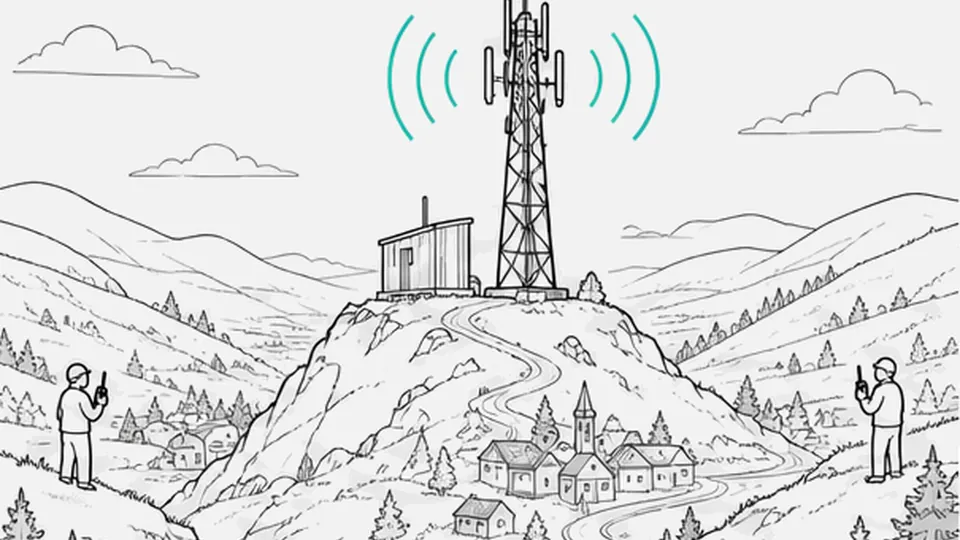
It usually sends with more power than a hand-held, from an antenna high above the ground around it.1 That height is the whole point.
Here is what happens when you press the talk button on a radio set to a repeater channel:
| Step | What happens | Frequency |
|---|---|---|
| 1 | Your hand-held sends your voice | Repeater input |
| 2 | The repeater on the hill or roof receives it | Repeater input |
| 3 | The repeater sends it out again, at the same moment, with more power | Repeater output |
| 4 | Every radio in the group hears it, even behind a hill from you | Repeater output |
Radios that talk straight to each other on one frequency work in simplex. A repeater needs a pair of frequencies, one in and one out, so the radio sends on one and listens on the other.1
Why repeater height matters
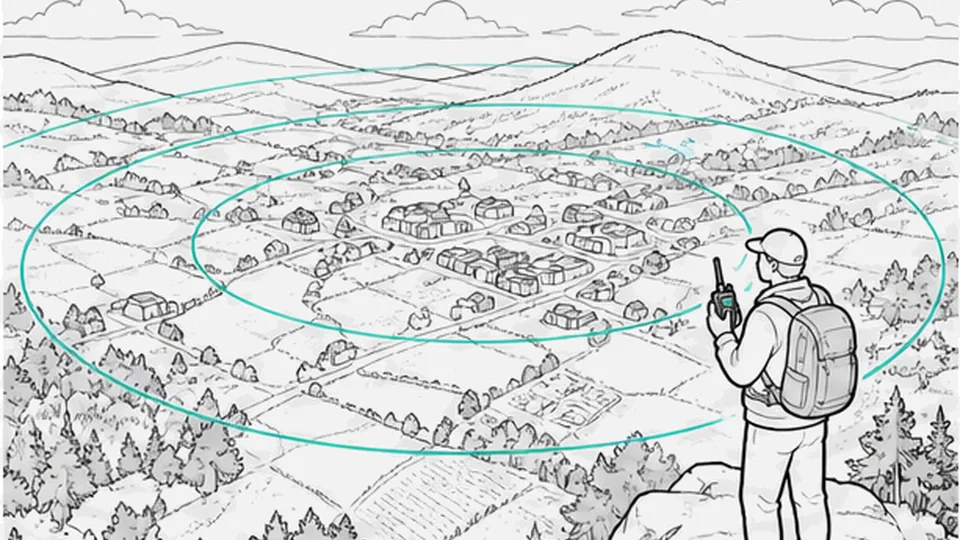
Radio waves at these frequencies travel in nearly straight lines, so the Earth's curve hides a radio below the horizon. ITU-R, the radio arm of the UN's telecoms agency, models this with an "effective" Earth 4/3 the real size for heights below 1,000 m.2
From that rule, the horizon for one antenna is 4.12 km times the square root of its height in meters.2 The table shows the line-of-sight limit between a hand-held at 1.5 m and a second antenna:
| Second antenna | Its height | Line-of-sight limit |
|---|---|---|
| Another hand-held | 1.5 m | 10.1 km |
| Repeater on a roof | 10 m | 18.1 km |
| Repeater on a mast | 30 m | 27.6 km |
| Repeater on a hilltop tower | 100 m | 46.2 km |
These are geometry limits, not a range. Hills, trees and buildings cut real distances well short of them. The longest-range walkie-talkies page explains what makers' range claims mean.
Check first how far two hand-helds reach on their own at your site. If the answer is too short, a repeater is the next step.
How far will my radios reach?
Pick your radios and where you use them. You get the distance most calls get through, standing at head height.
Radio repeater types compared
Repeaters come in several sizes, from a case on a car seat to a rack in a radio room. Here are the main kinds and the rule or example behind each:
| Type | Who uses it | Power | Paperwork |
|---|---|---|---|
| GMRS repeater | Families and groups in the US | Up to 50 W output3 | GMRS license4 |
| Portable GMRS repeater | Camps, events, off-grid groups | 5 W after the built-in duplexer on the Retevis RT97S5 | GMRS license4 |
| Business repeater | Companies, schools, venues | Up to 100 W, continuous, on the Motorola SLR 80006 | A business license78 |
| Vehicle (mobile) repeater | Crews who work near a truck | Hand-helds up to 6 W on some US business channels9 | Business license that names the frequency and power9 |
| Signal booster | Inside buildings and tunnels | Retransmits the licensee's channels only10 | Consent of the licensee10 |
| Repeaters linked over IP | Sites in several towns or buildings | Each site's own repeater | Each repeater licensed, plus the maker's link license11 |
Repeaters belong to licensed services. In Europe, PMR446 radios work radio to radio only: the rules exclude any base station, repeater or fixed set-up.12 In the US, FRS radios transmit only on their 22 channels, so a repeater's 467 MHz input is out of their reach.1314
GMRS repeaters for families and groups
GMRS, the licensed US service for individuals and their families, allows repeaters.4 A repeater sends on one of the eight 462 MHz main channels. Hand-helds reach it on the 467 MHz main channels.15
A hand-held may send on those 467 MHz channels only through a repeater or for a brief test.15 The full list of pairs, 15R to 22R, is on the GMRS frequencies page.
Power is capped by rule. A GMRS repeater's transmitter output may not exceed 50 W.3
One GMRS license covers the holder and their immediate family.4 The repeater owner chooses who uses it: anyone, or only named people. The owner may also bar specific people.4
Portable GMRS repeaters
A repeater does not have to live on a tower. The Retevis RT97S is a GMRS repeater in a carry case. It has a built-in duplexer and 8 programmed GMRS repeater channels.5
It runs from 12-24 V DC, a car plug or solar power.5 Retevis gives up to 5 W of output after the duplexer.5 Put it on a high point, add an antenna and cable, and a group in the valley below can reach it.
GMRS repeaters and the internet
GMRS rules limit network links. A GMRS repeater may connect to a network only to be operated by remote control.16
The rules also bar messages that travel over a wired control link and then go out from a GMRS station.17 Linking sites over IP, as businesses do below, is a business radio feature.
Duplexer: one antenna that sends and receives
A repeater sends and receives at the same moment, on two frequencies.1 A duplexer is a set of filters between the repeater and its antenna. It lets one antenna do both jobs at once.
Retevis builds a notch duplexer into the RT97S, so the user adds only an antenna and cable.5 Retevis states the output after the duplexer: up to 5 W.5
Business repeaters and licenses
In FCC rules a business repeater is a "mobile relay station". It is a base station that automatically resends, on a mobile frequency, what it hears from mobile radios.18 Mobile relay operation is licensed on frequencies below 512 MHz.7
Companies, schools, clinics and clergy groups qualify for the US Industrial/Business Pool.8 Rules in other countries are on the license page, and whole-site set-ups on business two-way radio systems.
Business repeaters are built to send all day. Motorola rates the SLR 8000 for up to 100 W in continuous duty. It runs analog, digital or mixed mode.6
Kenwood's NXR-1800E2 gives up to 40 W at a 50% duty cycle and 25 W at 100%. It repeats DMR Tier II or NXDN, one at a time.19
A DMR repeater carries two calls at once. Each of its two time slots is a separate talk path on the same pair of frequencies.20 The DMR radio page explains slots and talkgroups.
Vehicle repeaters and signal boosters
A vehicle repeater rides in a truck and relays hand-helds carried by the crew. On some US business channels, those hand-helds may run only above 150 MHz and at no more than 6 W.9
A signal booster is a different box. It receives, amplifies and resends signals into building interiors, tunnels and other spots where they are too weak.10
A booster may not extend the station's service area. A building owner or installer needs the express consent of the channel's licensee to run one.10
IP Site Connect: linking repeaters over IP
One repeater covers one area. To join a warehouse in one town with an office in another, makers link repeaters over IP, the network the internet runs on.
Each big DMR maker has its own name for this:
| Maker | Feature | Sites | How it works |
|---|---|---|---|
| Motorola Solutions | IP Site Connect | Up to 1521 | MOTOTRBO repeaters coordinate the calls, with no separate controller21 |
| Hytera | IP Multi-site (IP Connect in the US) | 32 repeaters22 | Hytera Tier II repeaters with an IP Connect license and a router11 |
| Kenwood | Multi-Site Conventional IP Network | Up to 1619 | A software option on the repeater, for digital and analog19 |
Motorola says IP Site Connect sites can sit in different states or even different countries.21 Each site needs only one radio channel. Radios roam from one coverage area to the next with no action from the user.21
The same feature helps on one site. Motorola names a high-rise full of walls and floors as a use case.21
Hytera's US data sheet adds the network side. The link can run over the internet, a private wide-area network, a local network or a VPN.11 Talkgroups can be set to reach only the local repeater or every linked site.11
Hytera says DMR radios of any brand work on its IP Connect system.11 The repeaters themselves come from the maker, so plan the linked sites on one brand of repeater.
Start with one repeater per site. Add the IP link when people at different sites need to hear each other.
Push-to-talk over cellular as the alternative
Push-to-talk over cellular uses phones or radio-like devices on the mobile network instead of a repeater. Zello, for example, works over Wi-Fi or cellular wherever there is internet.23 It connects to radio networks through radio gateways.23
Motorola's WAVE PTX does the same for its own radios. Its gateways link MOTOTRBO users on IP Site Connect, Capacity Plus and Capacity Max with WAVE PTX users.24 Motorola pitches this for staff outside radio coverage, such as drivers on smartphones.24
Questions
What is a radio repeater?
A fixed radio that receives on one channel and resends on another at the same time. It usually has more power and a high antenna.1
What is the difference between a repeater and a base station?
A base station is a fixed radio that talks directly with mobile radios. A repeater resends what it hears on a second channel so radios can reach each other through it.1
Do I need a license for a repeater?
Yes, in the US: a GMRS license for a GMRS repeater, or a business license for a business repeater.47 PMR446 rules in Europe exclude repeaters.12
Can FRS radios use a GMRS repeater?
No. FRS radios transmit only on their 22 channels and cannot send on the 467 MHz repeater inputs.131415
What is IP Site Connect?
Motorola's way to link MOTOTRBO repeaters over an IP network. Up to 15 sites act as one system, and radios roam between them.21
What does a duplexer do on a repeater?
It lets one antenna send and receive at the same moment. The Retevis RT97S has one built in.5
Sources
- RT97S full duplex portable GMRS repeater · Retevis
- MOTOTRBO SLR 8000 repeater · Motorola Solutions
Show all 24 sources
- 47 CFR 95.563: FRS channels · eCFR
- NXR-1800E2 UHF digital repeater · Kenwood
- MOTOTRBO IP Site Connect · Motorola Solutions
- Zello push-to-talk app · Zello
- WAVE PTX LMR interoperability brochure · Motorola Solutions